
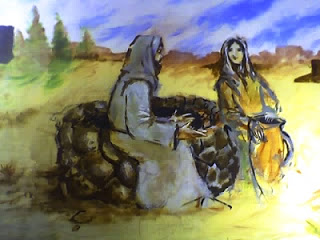
Cross-posting this essay written by Bob Ekblad on US election day in early November (source):
Today on Election Day here in the USA I’m choosing to re-affirm my choice of Jesus as Commander-in-Chief, and seek the Kingdom of God and his righteousness and justice first.
We live in a time of confusion and division around Christianity and nearly everything “Christian.” Jesus’ name has been used by people in power from the beginning, and false Christs, fake Christs, anti-Christs have always been in the world, as John writes: “even now many antichrists have appeared…. They went out from us, but they were not really of us” (1 Jn 2:18,19).
Christ is a title not a person! The person of Jesus has been detached from his title “Christ” and his name has been instrumentalized. Let’s look at how we name him and try to get some clarity about how we can more rightly identify him so we can decide whether we will follow him.
Some call him Christ, and he’s also called Lord, Savior, Jesus Christ, Lord Jesus Christ, Son of God or Jesus of Nazareth. Others insist on calling him Yeshuah, transliterating his Hebrew name to emphasize his Jewish identity.
It’s fine and even good to vary the names we use for Jesus… and Scripture itself includes many names and titles. What makes all the difference is who we understand Jesus to be, which will affect how we follow him (or don’t) today. Jesus’ teaching and actions in the New Testament show us concretely how he brings liberation (and how he doesn’t) as Israel’s Messiah (the Christ), the world’s Savior, and the image of God he reveals to us as God’s Son.
A more Jesus-like Christ
Though we may not yet recognize this, our particular understanding of how Jesus of Nazareth is “the Christ” will affect whether we refuse the threat or use of violence against national or personal enemies and pursue non-violent approaches (or not), pray for healing and spiritual freedom (or not), welcome immigrants and refugees and care for the poor (or not), refuse to pledge allegiance to a flag (or not), oppose the death penalty (or support it), and a host of others actions.
I am troubled when I hear people mention Christ, without naming Jesus. I hear “Christ” named almost exclusively rather than Jesus’ name from people who have become Eastern Orthodox. They are drawn to carefully crafted-creeds and glorious, cosmic enthronement of Jesus as Christ, but they risk missing the particularity of the very human Jesus visible in the Gospels. I also see a distancing from Jesus’ name in other circles where Jesus is too identified with Christendom, or particular or exclusive for their comfort. But does this really matter?
Yes, it really does matter! Jesus’ title, “Christ,” separated from his person as presented by the Gospel accounts gives us a disembodied idealized Christ—which also makes room for a controlling, violent one—or a passive, powerless one.
No knee will bow or tongue confess, or sickness be healed or demon leave in the name of “Christ”- as Christ is a title and not a name. And knowing Jesus in his particularity is essential if we are to rightly discern if someone claiming to represent Christ is or is not rightly representing him– as there are many false representations of Christ in the world now. For this reason, Jesus warns:
“See to it that no one misleads you. For many will come in my name, saying, ‘I am the Christ,’ and will mislead many” (Mt 24:4-5).
Jesus warns that “false Christs and false prophets will arise and will show great signs and wonders, so as to mislead, if possible, even the elect” (Mt 24:24).
The elect are currently being misled, so now is the time to clarify our vision—to repent (meaning “to think differently”).
The four Gospels give us details about Jesus and his teaching, each from a different angle, which help us differentiate the real from the fake. Jesus came to make God visible, not in strong-armed control, but in weakness and vulnerability– identifiable in nearly every detail of his life and teaching.
Jesus was conceived by a single mother, born into poverty in a nation colonized by a superpower. He was forced to flee to Egypt as a refugee to escape Herod’s genocide. Jesus was humble, serving his first thirty years as an unknown carpenter in Nazareth before joining the crowd of pilgrims to receive John the Baptist’s baptism of repentance for the forgiveness of sins in the Jordan River. There he was anointed by the Holy Spirit (as Christ) as he came out of the water, and the Father identified him as his beloved Son.
Jesus immediately left his homeland, Israel for 40 days in the wilderness where he was tempted by the devil. He then re-entered, deliberately locating himself in the marginalized North, in Galilee. There he taught, preached and ministered in homes, synagogues, villages, mountains, beaches and along the roadside—with a focus on the poor and excluded.
“The Christ” (without the Jesus of Nazareth particularity), is removed from the dusty, sweaty, human Galilean Jesus— who walked the roads of Roman occupied Palestine, teaching the masses, healing the sick, freeing people from evil spirits, and defending sinners from religious legalism. Jesus recruited ordinary people to become his disciples to practice his same practices, teaching them what it means to be children of God, to themselves make disciples. So let us be sure that we identify Christ in full alignment with Jesus of Nazareth, so we can rightly carry forward his movement! But what more does it mean to identify Jesus as “the Christ.”
A more Christ-like Jesus
Christ is the Greek translation of the Hebrew māšiyaḥ, meaning anointed. Every king in ancient Israel was anointed to their governing role by a prophet sent by God. These kings were often referred to as “the Lord’s anointed” (1 Sam 24:7,11; 26:9; 2 Sam 1:14; 2 Sam 2:5; 19:21)—though a final one was prophesied who would make all things permanently new—a King over a Kingdom of “justice and righteousness” (Is 9:7).
Jesus is not just a personal Savior, bringing eternal security to me and my tribe, who may already be protected by every means at our disposal (laws, pensions, stock portfolios, guns and national defense systems). Jesus of Nazareth is the Savior of the World, the cosmic Christ— the Sovereign of a Kingdom “not of this world.”
The prophet Nathan prophesied that David would have a descendant who would be King over a Kingdom that would never end. God spoke through Nathan in ways that suggest this future King would also be God’s Son, saying “I will be a father to him and he will be a son to me” (2 Sam 7:14). This coming King would be opposed by the rulers of this world- not embraced. So when they claim to embrace him we must be wary!
In Psalm 2 the nations, kings and rulers of the earth are presented as “taking a stand and taking counsel against the Lord, and against his Anointed (Christos in Greek) (Ps 2:2). The Lord declares: “I have installed my King upon Zion, my holy mountain” (Ps 2:6).
This King then speaks for himself quoting what the Lord has said to him: “You are my Son. Today I have begotten you ask of me, and I will surely give the nations as your inheritance, and the ends of the earth as your possession. ‘You shall break them with a rod of iron, you shall shatter them like earthenware” (Ps 2:7-9).
When Jesus of Nazareth began his earthly ministry, he knew himself to be the expected Christ (Jn 4:25-26; Mk 14:61-61), God’s own Son. His Jewish disciples and early Christians confessed him to be the Christ, the Son of God. Mark’s Gospel places Jesus’ title “Christ” and Divine identity as Son of God in its first line: “The beginning of the gospel of Jesus Christ, the Son of God” (Mk 1:1).
When Jesus was anointed by the Holy Spirit at his baptism, he was empowered to preach the good news to the poor, announce freedom to the captives, sight to the blind, heal the sick, cast out demons, cleanse lepers, raise the death. Jesus’ many healings were interpreted as signs confirming he was the awaited Messiah (Anointed One). Jesus affirms he’s fulfilling these Messianic signs when he tells John the Baptist’s disciples to tell him what they’d witnessed, referencing Isaiah 29:18, 26:19 and 35:5-6.
“The blind receive sight and the lame walk, the lepers are cleansed and the deaf hear, the dead are raised up, and the poor have the gospel preached to them” (Mt 11:5).
The religious leaders of God’s people refused Jesus’ identity as Israel’s Christ, and condemned him to death for blasphemy for identifying himself as God and prophesying the destruction of the Temple. They turned him over to the rulers of the Roman colonizers for death by crucifixion—thinking they were putting an end to a false Christ.
Jesus overcame of death through his bodily resurrection, demonstrating that he defeated the hostile nations, kings and rulers, whose non-human spiritual natures the Apostle Paul states Jesus will finally destroy, along with death itself (1 Cor 15:24-26).
In the meantime, Jesus is seated at the Father’s right hand, “far above all rule and authority and power and dominion, and every name that is named” (Eph 1:20-21). Since Jesus is the “head over all things to the church” (Eph 1:22), and we are seated with him “in the heavenly places” (Eph 2:6), we must refuse to come under powers hostile to Jesus and his Kingdom.
Since Jesus is raised from the dead, this means he’s still the same embodied Christ whom we are called to love and follow now.
Since many Jews expected the Messiah to liberate them from their enemies then and there, (including Roman colonizers), his death by crucifixion created a crisis of faith. We see the resurrected Jesus addressing this very question as he journeys alongside two disciples disillusioned by his death.
“O foolish men and slow of heart to believe in all that the prophets have spoken!,” says Jesus, asking them: “Was it not necessary for the Christ to suffer these things and to enter into his glory?”
Jesus then explained to them the things concerning himself in Moses and the prophets. It is Jesus’ own teaching regarding his redemptive suffering and death that distinguishes his way of being the Christ, King of the Jews and Savior of the world from pretender Christs.
I’m amazed as I seek to deliberately read the Bible on the Road to Emaus, where I see the suffering Messiah revealed in story after story. In some places this suffering is clearly stated, as in the prophet Isaiah’s depiction of the Servant of the Lord– not as a violent, conquering sovereign, but as a suffering yet ultimately victorious servant.
“He will sprinkle many nations, kings will shut their mouths on account of him” (Is 52:13).
“He was despised and forsaken of men, a man of sorrows and acquainted with grief; and like one from whom men hide their face he was despised, and we did not esteem him.Surely our griefs he himself bore, and our sorrows he carried” (Is 53:3-4).
Jesus confronted his disciples as they jockey for power in what they thought would be Jesus’ earthly kingdom, clarifying his humble way of being Christ.
“You know that the rulers of the Gentiles lord it over them, and their great men exercise authority over them. “It is not this way among you, but whoever wishes to become great among you shall be your servant, and whoever wishes to be first among you shall be your slave; just as the Son of Man did not come to be served, but to serve, and to give his life a ransom for many” (Mt 20:24-28).
This is the King, the One God who emptied himself, taking on the form of a human servant, becoming obedient to the point of death, whom I vote for today on Election Day here in the USA (though I exercised my civil responsibilities too). As we face the tumultuous days and years ahead, many will be tempted to abandon faith, lose hope and even endorse violence. Now is the time to re-focus, to re-affirm our total allegiance to Jesus, following him as disciples who make disciples, empowered by the Holy Spirit to embody the only truly life-giving alternative in these dark times.
Bob’s recent talks on prophetic ministry given at Ambrose University in Calgary are available below:
– Lecture 1 – Prophetic witness to Jesus and his Kingdom in the face of rising inequalities, authoritarianism and persecution today
– Lecture 2 – Prophetic seeing with Dinah & Jesus: Reading Genesis 34 on the Road to Emmaus
MORE FROM BOB EKBLAD
Preparing for War Jesus’ Way
The world is in turmoil. The USA increases defense spending, and pressures other nations to increase defense spending. Many Western nations are sending weapons to war zones while themselves preparing for war. The defense industry is booming. How do we as Jesus followers position ourselves to face these pressures?

Peace through Weakness
Peace through strength is a foreign policy doctrine that calls for military superiority to deter aggression, which the Trump Administration now brazenly proclaims using hostile, threatening rhetoric by leaders loudly self-defining as Christian. Let us instead lift up Jesus and his words and actions in the face of threats of violence and acts of war.

Lifting Our Eyes
The Psalmist’s remedy for despair is to invite us to direct our gaze to the highest authority, before whom we intercede– putting our total hope in the One who hears the cries of the oppressed, the groans of prisoners, and intervenes to bring liberation.
Something went wrong. Please refresh the page and/or try again.


Leave a Reply