

Cross-posting this timely essay by my friend, Bob Ekblad (source):
The world is in turmoil with numerous wars and increasing insecurity. The USA is increasing its defense spending, and pressuring European nations to increase their defense spending. Many Western nations are sending weapons to Ukraine, to Israel, and elsewhere– and are themselves preparing for war. The defense industry is booming. How do we as Jesus followers position ourselves to face these pressures?
I was born in 1957 in the midst of the Cold War. Less then a month before I was born, the Soviet Union launched Sputnik, the world’s first satellite, using an intercontinental ballistic missile (ICBN), propelling the US into an arms race, accelerated U.S. space and defense spending.
Dwight Eisenhower was the President of the United States. He was known for his policy of containment of the Soviet Union through preparing for and threatening “massive retaliation” through nuclear weapons against communist aggression. Since the United States had dropped the atomic bomb on Hiroshima and Nagasaki during WWII in in August 6 and 9th, 1945, killing 150,000 to 246,000 Japanese people (mostly civilians)– this kind of a deterrence was felt as a very real threat.
Eisenhower expanded the CIA’s covert operations, overthrowing democratically-elected Presidents Mohammad Mosaddegh of Iran and Jacobo Arbenz of Guatemala. The US staged coups, installed repressive dictatorships around the world, with devastating consequences still felt today. He increased defense spending.
I remember well my parents upset during the Cuban Missile Crisis– the 13-day nuclear standoff with the Soviet Union that ended October 28, 1962, six days before my fifth birthday.
From as early as I can remember the threat of communists taking over America (and the world) was presented as a real possibility. If they came us kids would be separated from our parents, put into re-education camps until we renounced our faith. We had to be strong and be willing to fight, and even kill to protect the free world.
I grew up in a family that was very actively Christian. As a young child I attended church regularly, and went to a private Christian school first through seventh grade. I was deeply impacted by the message of Jesus– that God so loved the world that he gave his son Jesus, to save us from our sins.
I was inspired by my Swedish-born grandfather, Folke Ekblad, who was a pastor to immigrant communities, his older brother Hjalmar who served as a missionary in North China beginning in 1913, and his daughter Doris– who served her entire life as a missionary to Hong Kong. As a young person I knew and looked up to these family members as my heros, and wanted to follow their example.
I attended evangelistic crusades where I heard Billy Graham, and was especially moved by David Wilkinson and Nicky Cruz’s ministries to New York street gangs. I was deeply inspired by Richard Wurmbrand’s Tortured for Christ, where he recounted 14 years of imprisonment and torture due to his ministry as the Romanian Lutheran pastor. I felt recruited into Jesus’ mission to reach the poor and unreached– which for me most certainly had to include Russians, Chinese, Vietnamese– communists or not.
I remember well the day in 1963 when President John F. Kennedy was assassinated, and Lyndon B. Johnson became president. On September 7th, 1964, less than two months before my 7th birthday, when he was campaigning against Barry Goldwater, my parents Republican choice, he released a video as part of his election campaign that marked my life– traumatizing me.
For years afterwards I had a re-occurring nightmare where I envisioned a little girl (and the world) being annihilated by a nuclear war. I would awake screaming in terror. I later learned that my nightmare was this very video (see below).
I think President Johnson’s words may also have entered my soul– mixing with the Gospel message I was already steeped in.
“These are the stakes. To make a world in which all of God’s children can live, or to go into the dark,” warned President Johnson, with the scene of a mushroom cloud rising on our black and white television set. “We must either love each other or we must die.”
Johnson’s final words on the video were: “Vote for President Johnson on November 3rd. The stakes are too high for you to stay home. ” likely contributed to his landslide victory on November 3rd, 1964– my 7th birthday.
During Johnson’s years as President the Vietnam War escalated, and the Civil Rights and anti-Vietnam War Movements were dramatically visible. I was ten when Martin Luther King Jr. was assassinated, and eleven when Richard Nixon was elected president.
As the Vietnam War body count mounted and I grew older, the very real possibility of eventually being drafted at age 18 caused me great alarm. Would I, could I, should I prepare to kill enemy soldiers to protect my country, and especially my family and my freedom to worship Jesus?
I had carried a rifle while hunting for deer and elk with my dad and brothers from an early age. I remember recoiling in horror at the idea of aiming my rifle at a human being and pulling the trigger.
As a young man attending a private Christian school, weekly church services, and confirmation classes I been exposed to Scripture through hearing hundreds of sermons, memorizing lots of Bible verses and hearing moving accounts from missionaries of every kind. It was obvious to me then (and now) that killing enemy combatants (or anyone), was clearly the opposite of Jesus’ way of love and his Great Commission to us to “make disciples of all the nations” (Mt 28:19).
“The Son of Man has come to seek and to save (not to seek and destroy) that which is lost” (Lk 19:10).
Certainly we too as Jesus followers must not even consider killing anyone– though I’d heard people defend the bombing of Hiroshima and Nagasaki and preparing to use nuclear weapons as a “necessary” or “lesser evil.” I only had to think back to the horror of the young girl being annihilated to refuse all such justifications.
Jesus teaches “to love your enemies, do good to those who hate you, bless those who curse you, pray for those who mistreat you” (Lk 6:27-28).
I knew that the Apostle Paul called himself a once “persecutor and a violent aggressor,” who was shown mercy and himself recruited.The resurrected Jesus met him while on his way to arrest his followers, asking him “Why are you persecuting me?” Paul describes himself as the worst of sinners saved by Jesus– an example for those who would believe in him for eternal life (1 Tm 1:12-17). So shouldn’t any terrorist, communist, cartel drug lord or enemy combatant be in crosshairs of God’s love (and ours!)?
“Do not be overcome by evil, but overcome evil with good” (Rm 12:21), writes Paul– after calling for enemy love, and the refusal of all vengeance.
“Perfect love drives out all fear,” I was told and read myself in 1 John 4:18. Yet fear of nuclear war, communists, and liberals was rampant in conservative Christian circles– reinforced by drills at school to prepare for a possible invasion. Protecting our freedom required having a strong military, carrying a big stick, and not being afraid to use it, I was told. But what does it truly look like to tap into that perfect love?
I know for sure that it has nothing to do with vengeance! Jesus rebuked his vengeance-seeking disciples, telling them: “The Son of Man did not come to destroy men’s lives, but to save them” (Lk 9:56).
When he was being arrested he stopped his disciple who sought to defend him, telling him: “Put your sword back into its place; for all those who take up the sword shall perish by the sword” (Mt 26:52).
Nowhere in the Gospels do I see Jesus calling for homeland defense. Rather he stressed to his disciples that when they see Jerusalem surrounded by armies to “flee to the mountains and “leave the city” (Lk 21:20-21).
He tells disciples not to protect him: “Or do you think that I cannot appeal to my Father, and he will at once put at my disposal more than twelve legions of angels?” (Mt 26:53).
Today I recoil as I hear people who call themselves Jesus-followers arguing for homeland defense, retaliatory violence, or any justifications for the taking of human life. The young girl in the video, picking a daisy with the countdown ending in an annihilating explosion is current reality– happening to children (and adults) in Gaza, Lebanon, Iran, Yemen, Ukraine, Russia, Sudan, Eastern Congo and other places.
The way of Jesus is another way. “My kingdom is not of this world,” he says– though it is certainly still “in this world.” I think of a Syrian Christian who shared how her faith community prayed as their city was bombed– that the mortars would fail to hit their targets– and they didn’t. She told me how people noticed the effects of their intercession, and took comfort. May we seek alternative ways to embody Jesus’ way of peace!
May we cry out for God’s mercy and pray and work for peace. May we categorically refuse the way of death and diligently embody Jesus’ life-saving message in the face of growing hostilities now.
Check out Bob’s podcast “Disciple: Word, Spirit, Justice, Mission” on Apple or Spotify. Also take note of the new editions of Guerrilla Gospel and Guerrilla Bible Studies, now entitled Liberating Gospel and Liberating Bible Studies, available here.
MORE FROM BOB EKBLAD
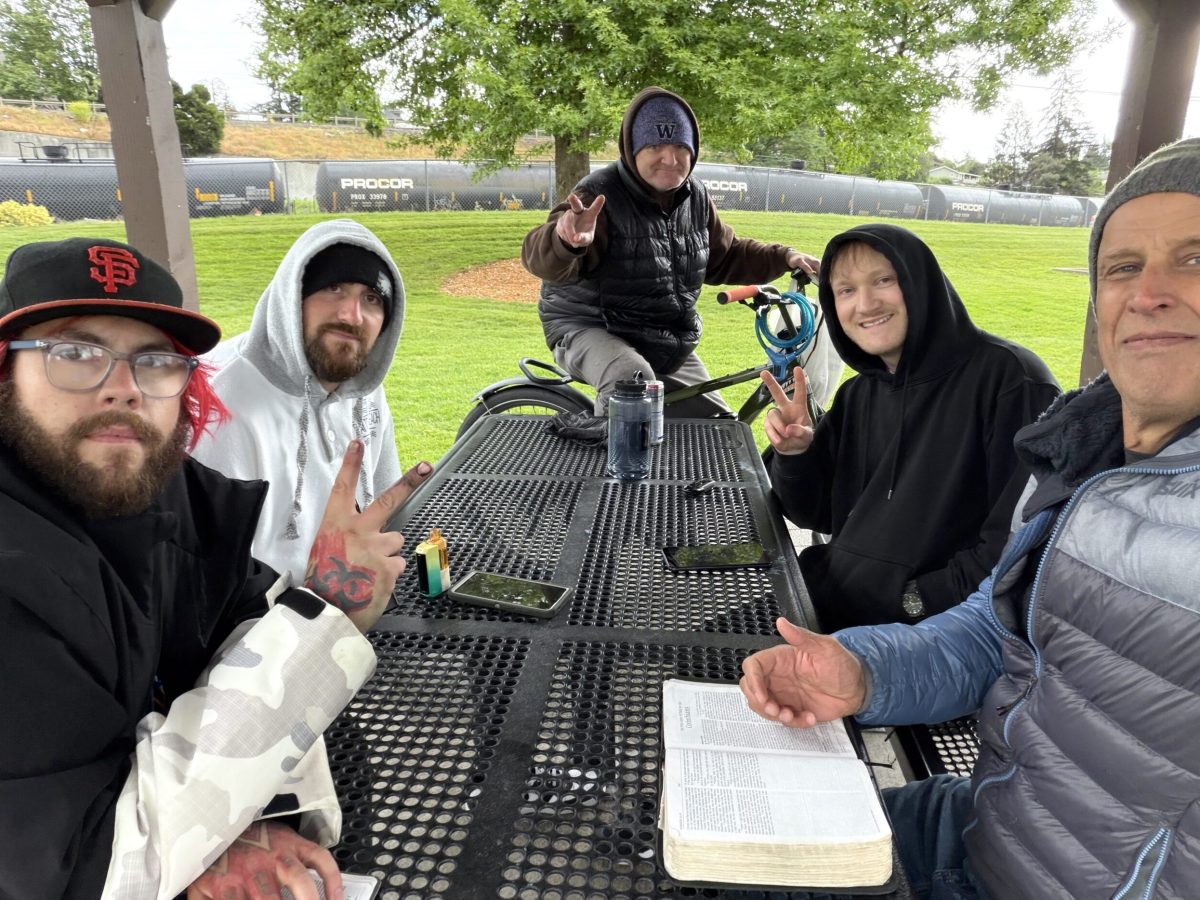
Peace through Weakness
Peace through strength is a foreign policy doctrine that calls for military superiority to deter aggression, which the Trump Administration now brazenly proclaims using hostile, threatening rhetoric by leaders loudly self-defining as Christian. Let us instead lift up Jesus and his words and actions in the face of threats of violence and acts of war.

Lifting Our Eyes
The Psalmist’s remedy for despair is to invite us to direct our gaze to the highest authority, before whom we intercede– putting our total hope in the One who hears the cries of the oppressed, the groans of prisoners, and intervenes to bring liberation.
Biblical Wonderings as America Falls Apart
Sharing a blog post by Bob Ekblad, an American friend of mine who loves people, studies diligently, takes the Bible very seriously, and embodies his theology in liberating pastoral ministry in his community. I think his concerns are worth a read by American Christians who take the Bible seriously.
Something went wrong. Please refresh the page and/or try again.


Leave a Reply