
Cross-posting this blog by my friend, Bob Ekblad (source):
Peace through strength is a foreign policy doctrine that calls for military superiority to deter aggression. It was famously championed by President Ronald Reagan in the 1980s, but has been taken to new extremes by the Trump Administration’s words and actions— now brazenly proclaimed using the most hostile, threatening rhetoric by leaders loudly self-defining as Christian. Let us lift up Jesus, and his words and actions in the face of threats of violence and acts of war.
Jesus himself proclaimed and modeled peace through what looks like weakness, which is stated most clearly in his response to his disciple’s own attempts to grab power.
“You know that the rulers of the nations lord it over them, and their great men exercise authority over them. “It is not this way among you, but whoever wishes to become great among you shall be your servant, and whoever wishes to be first among you shall be your slave; just as the Son of Man did not come to be served, but to serve, and to give his life a ransom for many” (Mt 20:25-28).
Yet many self-proclaimed Christians today openly espouse the Seven Mountain Mandate, which advocates for Christians to actively take and rule over seven identified spheres of influence in society (religion, family, government, education, media, arts/entertainment, and business). See Matthew D. Taylor’s excellent The Violent Take it By Force: The Christian Nationalist Movement that is Threatening our Democracy for a detailed description.
On Wednesday at Tierra Nueva I led a Bible study with men and women in recovery about Jesus’ way of peace through weakness. We started by discussing how Jesus proclaimed a kingdom “not of this world,” identifying the underdogs as primary beneficiaries. “Blessed are the poor in spirit, for theirs is the kingdom of heaven,” he promised. “Blessed are the meek, for they shall inherit the earth,” he announced. This delighted our people.
The Apostle Paul lifts up Jesus’ self-emptying love- to the point of death on a cross, as the way he defeats evil, announcing the eventual destruction by Jesus of the principalities and powers—and finally death itself as the last enemy (1 Cor 15:26). Wow would this be welcome!
We read together how Jesus calls his followers (“you who hear”), saying: “love your enemies, do good to those who hate you, bless those who curse you, pray for those who mistreat you” (Lk 6:27-28).
We discussed how Secretary of War Pete Hegseth recently prayed the opposite actions in one of his public worship services: “Let every round find its mark against the enemies of righteousness and our great nation.” “Give… overwhelming violence of action against those who deserve no mercy.”
Hegseth justifies his violence with the help of pastors and theologians from his church, Christ Kirk DC, the Washington DC branch of the Communion of Reformed Evangelical Churches, where a pastor recently preached a sermon on “biblically-informed hatred” (see this article). In this sermon the pastor did not appear to carefully distinguish between hating the sin and loving the person.
While hating what is evil is called for (Rom 12:9), Jesus consistently distinguishes between people, including enemies, who he calls us to love, and predatory evil (unclean spirits, powers and principalities, sin), which he calls us to cast out or resist. This message is welcomed by anyone who has suffered physically for their addictions and crimes through homelessness, incarceration, deportation, and every manner of loss.
In Ephesians 2, Paul writes how Jesus himself is our peace, breaking down the dividing wall, and abolishing in his flesh the hostility itself, and laws and commandments contained in ordinances, reconciling us through the cross by putting to death the hostility (Eph 2:14-18). Any violence attributable to Jesus is against non-human powers like walls, laws and commandments and hostility itself– never against people.
Followers of Jesus who still use Old Testament texts to justify violence against people and pray cursing Psalms against flesh and blood enemies must be helped to see they are going directly against the teachings of Jesus—with devastating consequences.
Since September 2025 Pete Hegseth has ordered over 58 strikes on boats in the Caribbean Sea and Eastern Pacific allegedly trafficking drugs, killing over 194 people from poor backgrounds (see this article and this response), with no proof offered that they were trafficking drugs.
The people at Tierra Nueva’s Bible study were outraged by the US Military’s killing of alleged drug traffickers– with no proof, no trial, no warning. We all know people who have turned away from drug dealing to become followers of Jesus!
In a country where people on the margins pay for their every crime, it doesn’t escape our people’s notice that the crimes of the rich and powerful often go unaddressed or are pardoned. There has been no formal acknowledgment let alone apology for the US bombing under Hegseth’s command of the Shajareh Tayyebeh girls’ school in Minab, Iran that killed 156 to 168 children.
Hegseth’s hateful rhetoric and actions follow the US President’s lead, who since then has threatened to “blow Iran off the face of the earth” and bomb it “back to the Stone Age.”
The other day I was deeply disturbed to learn about a Christian nationalist event, “The Rise of the Statesmen” featuring all-White speakers, most of whom are pastors, organized here in Washington State on Juneteenth and Father’s Day weekend. This event appears to promote and even celebrate patriotism, and peace through threats of violence—on a day when they should be celebrating the emancipation of enslaved African Americans in the United States. That this is happening at a time when Black Americans and other people of color are being stripped of their voice and vote through Supreme Court-empowered gerrymandering, only deepens a growing offense.
This Sunday’s (May 17) Christian nationalist worship service at the National Mall in Washington DC, Rededicate 250: A National Jubilee of Prayer Praise and Thanksgiving, which features Hegseth and other Trump Administration official speakers, shows that the escalation of colonial Christendom is highly organized and well-funded. Sitting back in despair or thinking our democracy will survive and all this will somehow go away is at best dangerous denialism and at worst complicity with evil.
In the face of ascendant co-opting of the name of Jesus at the service of anti-Christ agendas, now is the time to realign ourselves with Jesus and his peace through weakness (meekness).
The word of the cross subverts the powers
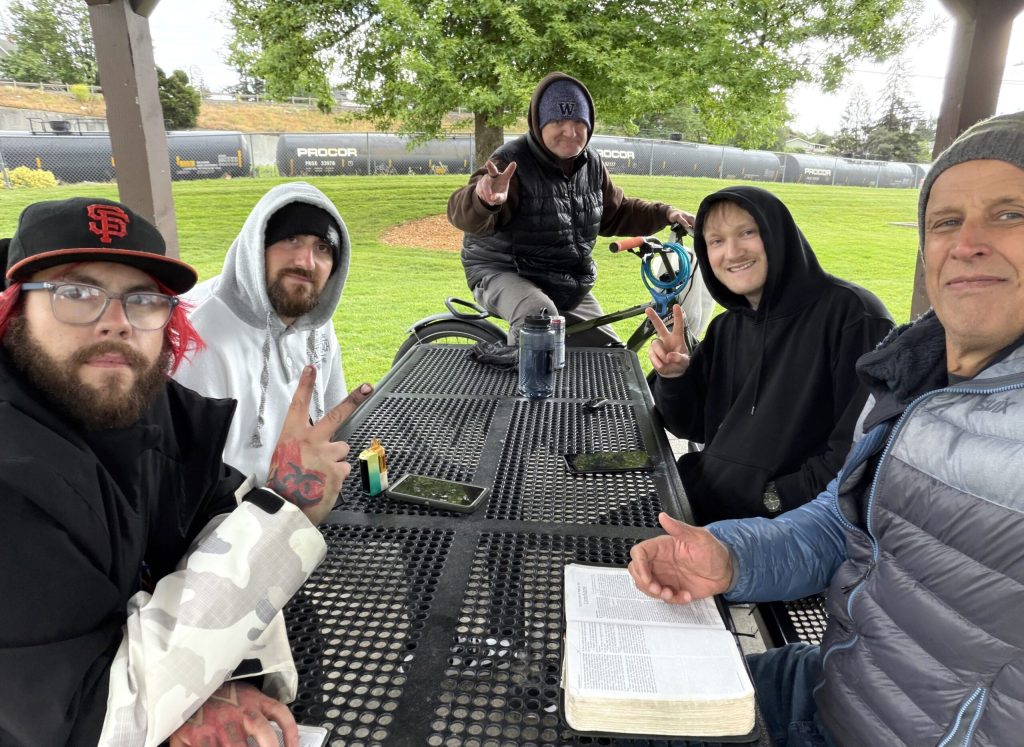
On Friday afternoon at Lyon’s Park in Mount Vernon, Washington I led Bible studies with four men we’d originally met on the streets who are now in recovery. We talked about Jesus’ way of peace through weakness. We read and discussed together sections of 1 Corinthians, where the Apostle Paul writes compellingly about peace through weakness—which he calls the word or message of the cross.
“We preach Christ crucified, to Jews a stumbling block and to Gentiles foolishness, but to those who are the called, both Jews and Greeks, Christ the power of God and the wisdom of God. Because the foolishness of God is wiser than men, and the weakness of God is stronger than men” (1 Cor 1:23-25).
“What do you think of this?” I ask the men under a covered picnic table.
“It’s super cool,” said Jordan (pictured left above), who himself has survived some 16 overdose deaths from fentanyl.
“Jesus gave his life for us, to save us from our sins,” he said.
We discuss together how Paul understood clearly that this message of Jesus defeating sin and death through himself submitting to human execution looks foolish. But Paul’s explanation flips the script in a way that invites us to make a choice—are we in with Jesus or not?
“I’m in,” said Jordan– and Rich, Spencer and Gino agreed.
“For the word of the cross is foolishness to those who are perishing, but to us who are being saved it is the power of God” (1 Cor 1:18).
When anyone claiming to be Christian and their political allies refuse the word of the cross as foolishness, justifying instead violence or the more rational sounding “peace through strength”—they are self-identifying as among “those who are perishing.” In contrast, Jesus’ weak-looking way of suffering love is the power of God “for all who are being saved.”
According to the Apostle Paul, God opposes this “wisdom of the wise” as doomed-to-death, and declares that the spokespersons for the world’s wisdom will be shown to be foolish.
“For it is written, “I will destroy the wisdom of the wise, and the cleverness of the clever I will set aside.” Where is the wise person? Where is the scribe? Where is the debater of this age? Has not God made foolish the wisdom of the world?” (1 Cor 1:19-20).
As we look at political and economic power amassing on one side of the political divide, authoritarianism, threats of violence and war against enemies, White supremacy, harsh immigration policy and so many dark forces seemingly winning, we do not yet see this prophesied demise. But we must remember to strengthen ourselves in the preaching of the foolishness of the cross—which has the power to save as we choose to actively believe (1 Cor 1:21).
There between Interstate 5 and the Skagit River around a picnic table we read the next verses that describe the stronger way of the foolishness of God, which people found delightful.
“To those who are the called, both Jews and Greeks, Christ the power of God and the wisdom of God. Because the foolishness of God is wiser than men, and the weakness of God is stronger than men” (1 Cor 1:24-25).
The final verses of our Bible study helped us all see the alternative community of those Jesus chooses, which gives hope in the face unity over and against a common enemy.
“For consider your calling, brothers and sisters, that there were not many wise according to the flesh, not many mighty, not many noble; but God has chosen the foolish things of the world to shame the wise, and God has chosen the weak things of the world to shame the things which are strong, and the base things of the world and the despised God has chosen, the things that are not, so that he may nullify the things that are, so that no one may boast before God” (1 Cor 1:26-28).
Everyone in our two Tierra Nueva groups could identify themselves as included among the called and chosen here. They found this deeply encouraging as they’ve been excluded from so many other circles. May you find your place in humble Jesus’ company of called and chosen ones, so you can journey with greater hope through these distressing times.
MORE FROM BOB EKBLAD

Lifting Our Eyes
The Psalmist’s remedy for despair is to invite us to direct our gaze to the highest authority, before whom we intercede– putting our total hope in the One who hears the cries of the oppressed, the groans of prisoners, and intervenes to bring liberation.

Biblical Wonderings as America Falls Apart
Sharing a blog post by Bob Ekblad, an American friend of mine who loves people, studies diligently, takes the Bible very seriously, and embodies his theology in liberating pastoral ministry in his community. I think his concerns are worth a read by American Christians who take the Bible seriously.
Meditations on Election Day
Cross-posting these words from Bob Ekblad, biblical meditations for Christians on the United States’ election day.
#Election #Meditation #Christian #President #Trump #Harris #Jesus
Something went wrong. Please refresh the page and/or try again.


Leave a Reply