
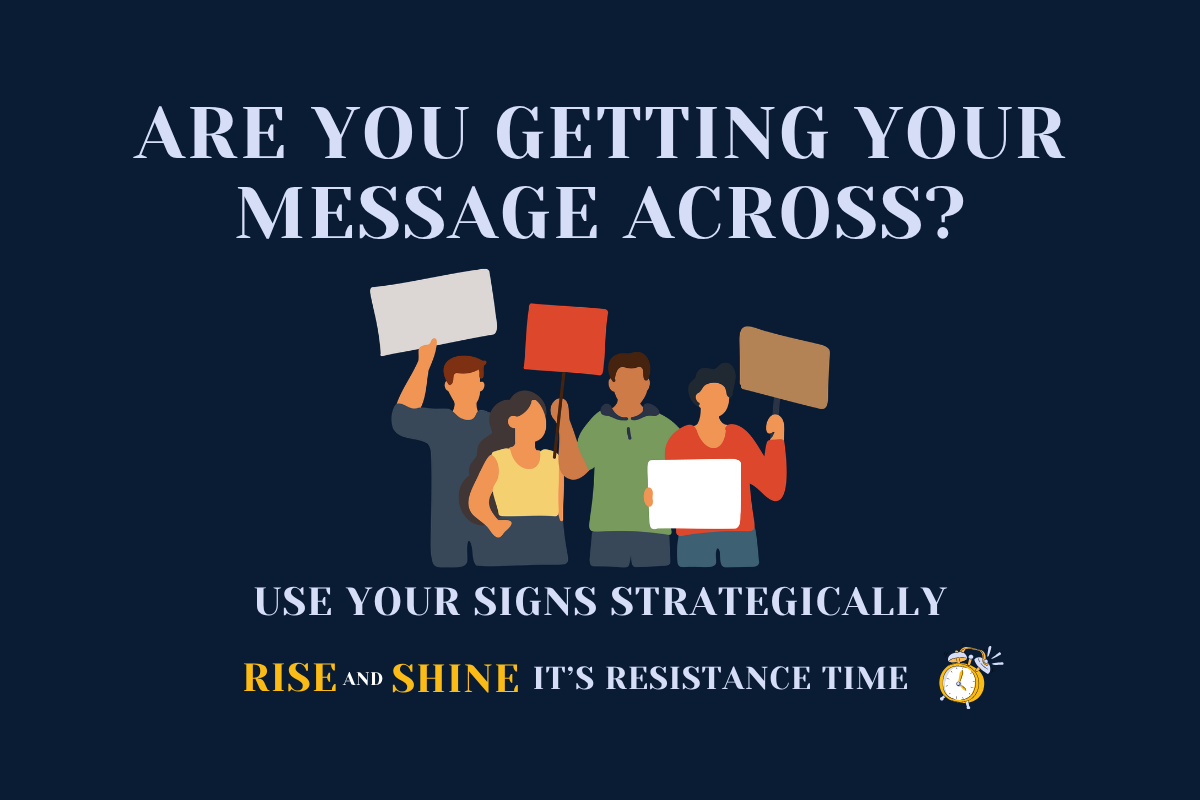
Cross-posting this weekend read from Rise and Shine (source). You can sign up for their periodical emails with tips on nonviolent resistance HERE:
While visiting a relative, I happened to drive past the weekly demonstration that takes place at the intersection of two busy streets. Around 20 people held signs as drivers like me honked in support.
Here’s the problem: I couldn’t read any of their signs.
My eyesight is good, but the handwriting was small, thin, and sometimes illegible. Since I’m always a fan of nonviolent protest, I honked my horn in a cheerful rhythm even though I could make out only two words: Trump and Iran. I turned the corner hoping they were protesting against Trump’s illegal, senseless war in Iran–not for it.
Stand-out actions like this are a staple of nonviolent action in the United States. At intersections, along busy streets, on highway overpasses, small to midsized groups of people scrawl a message on cardboard in sharpie. In my area, the most dedicated are out there rain or shine, and even through the bitterly cold snows in the winter. I’ve often been among them.
Looking at this demonstration from the outside, however, gave me a different perspective. What are the impressions that the driver or passerby takes away? Do they know what you stand for? Is your message understandable to people who aren’t already on your side? (Those people are sometimes literally by your side, holding the sign next to yours.) Are your signs persuading people who might disagree with your point-of-view?
Whenever we’re going to a street demonstration, we should consider two things:
- First of all, is your message readable? Remember: drivers are watching traffic, trying to stay in their lane, paying attention to the stoplights, avoiding other cars. They have 2-3 seconds to look at you. That’s it. Make sure your sign’s message and style translate at a glance.
- Second, is your message effective? Think about who you’re talking to–and what you want them to do. An activist tool called the Spectrum of Allies helps us think through these questions.
 Spectrum of Allies, adapted by Rivera Sun Spectrum of Allies, adapted by Rivera Sunfrom the work of George Lakey and Training for Change |
The Spectrum of Allies helps us think about who we want to reach and what we want to say. At a weekly stand-out action at your town’s busiest intersection, you’re often reaching the general public. Depending on where you live, you can make an educated guess about what the most common viewpoints on the issues are. This can help you craft your message. But even beyond this, you can tailor your slogans, signs, and points to particular audiences to achieve a specific change of mind, heart, or behavior.
Are you trying to call likeminded souls (your passive allies) into action? If so, craft your signs to tell them what to do, not just what you oppose. Is there a specific action they can take, like boycotting a product, contacting a decision maker, or making plans to join an upcoming action
Are you trying to inform new people (oblivious neutrals) about what’s going on? Then make sure your signs are informative, not just oppositional. Doublecheck that they make sense to someone who has no idea what you’re talking about. And bonus points if at least one sign hints at where people can learn more.
Are you trying to persuade people who don’t agree with you (passive opponents) to change their minds? Think about the values they care about and frame your issue in those terms. Make it clear and persuasive to their worldview, not yours. After all, if they already shared your perspective, they’d already be holding a sign with you.
Are you trying to convince the people involved in the injustice (active opponents) to stop what they’re doing? Again, think about what motivates these people. Why would they stop? Is there a better option? Are there consequences they should consider, like moral issues, the illegality of their actions, or the economic risk of a potential strike or boycott? Articulating these points helps frame a persuasive argument to people about why they should cease and desist.
Your weekly demonstration group can also make thematic choices from week to week, or even month to month. Here are three examples:
- Passive allies: Consider this: spend one month tailoring your messages to try to persuade passive allies to join you. One sign points out the injustice. The next says simply: JOIN US. The third says something like: EVERY SAT – 10AM – HERE.
- Oblivious neutrals: The following month, your group is bigger and more visible, thanks to all your new friends who have joined you. You decide to use your ability to display more signs to educate new people about what’s going on. Each sign could point out a different statistic or point about the issue. The signs at the two ends of your line of demonstrators should clearly and simply say the name of the issue, i.e. STOP THE IRAN WAR! or NO ICE! That way, drivers with only a few seconds to glance your way know what you oppose and can quickly see that everyone standing with you shares that view.
- Active opponents: If your protest group wants to deliver a message to the people causing the harm, you can switch your location to a specific area that they’re most likely to be in. This could be outside a bank’s entrance when you’re pushing for divestment. Or an employee parking lot at a business that’s complicit in weapons-making. Your signs should specifically make a compelling case for what you want these people to do (or stop doing). For example, if you’re demonstrating outside the gates of an ICE facility, you can hold signs that say OBEY THE LAW, LEAVE OUR CITY, STOP TARGETING SCHOOLS, etc.
Strategy is about rethinking your tactics (like a weekly demonstration) and improving them so you can achieve your specific goals (like bringing more people into the campaign) that help you achieve the broad aim of the campaign or movement (like ending a war or stopping the immigration crackdown).
Considering timing and location can also make your demonstrations more effective. Backbone Campaign’s Action Brigades hold overpass bannering action during rush hour as tens of thousands of commuters pass by their short, large, and highly-visible signs. The Ground Zero Center For Action holds small demonstrations outside the gates of a nuclear submarine facility, aiming to keep soldiers from rushing us into nuclear war. Immigrant rights groups have been banging pots and pans, singing, and ringing bells outside detention centers so people inside know that the community is present and has not forgotten them.
Democracy and nonviolent action go hand-in-hand. With the redistricting wars, the slam-dunk of the midterms has been thrown into question as Republicans steal seats through racist gerrymandering. With their own policies turning people against them, they’ve rigged the courts and redrawn the maps to make it harder for the democratic will of the people to be expressed and empowered through the polls.
Weekly demonstrations can be powerful . . . if you use your nonviolent power wisely. One way to outmaneuver the manipulation is to do democracy through nonviolent action. No amount of redistricting can stop an overwhelming tide of people voting bad actors out of power. Toward this end, your stand-out actions can take aim at two different goals over the next 5 months.
- Move passive allies into action. The largest voting bloc in the nation are the people who don’t vote, especially at midterms. Use your demonstrations to make a compelling case as to why they should get to the polls in November. You can either choose a location where you know supporters of your views live (such as particular neighborhoods, colleges and universities, businesses that align with their values, or at cultural events like music or art events that draw your community together) . . . or you can make your case to the general public because everyone should participate in democracy, regardless of political views. You can emphasize checking on your voter registration status or encourage people to talk to their friends about voting this year.
- Turn active opponents into passive opponents. This takes skillfulness and thoughtful strategy to pull off, but is achievable. Swinging voters from one candidate to another is the work of democracy. But as we said earlier, you have to speak their language and talk about what they care about, not what you care about. Economic issues, cost-of-living, fuel prices are persuasive messages for people across the political spectrum. Try something like: VOTE! WE CAN’T AFFORD NOT TO.
Remember readability! In my conservative area of rural Maine, I live on the main road for the 5 towns in our shared valley. I’m going to put out yard signs that spell out a message one word at a time. As the drivers go down the road, they’ll see it at a speed and size they can’t miss.
Your weekly demonstrations can do the same, with each person holding one sign with one word on it. With 4-6 people, you can deliver a short yet potent message. If you have 10-12 people who regularly join you, you can use two different messages and space yourselves out across several blocks.
Recruit new people! You can use your single-word signs as a way to recruit new people and give them a specific reason to show up. You need someone to hold the sign that says WE, for example. Or, you can call for 7 new people to pledge to hold a 7-word slogan at the next demonstration. Or ask them to commit to coming weekly from now until November. It’s a tangible and direct way to show up in this critical time.
We study strategy for nonviolent action because we need to become more effective at using the most powerful tools on the planet. We know that nonviolence is the most successful way to topple dictators, oust authoritarians, and protect democracy. While it takes more than demonstrations to achieve these kinds of goals (usually strikes, boycotts, nationwide shutdowns are also involved), demonstrations have almost always played a part in these historic movements. Using our stand-out actions more skillfully is how we turn a largely symbolic protest into a transformative part of social change.
In solidarity,
Rivera, Ken, and the Pace e Bene Team


A Backbone Campaign Solidarity Brigade. Photo from Backbone Campaign.
Backbone Campaign Offers Tools for Artful Activism
Giant banners. Light projections. Inflatable orcas (or anything). These are just some of the tools of artful activism that Backbone Campaign helps communities deploy locally. They coordinate regular virtual calls for creative demonstrations. They host trainings in the skills you need. In some areas, you can also join one of their solidarity brigades that is holding overpass banner actions.
Learn how to use a giant banner at a freeway overpass.
Find banners kits for overpass and freeway demonstrations.
Connect to a solidarity brigade – or start one.
Find props, imagery, and creative tools.
 Over 683 people have connected to Rise & Shine: It’s Resistance Time, our weekly newsletter packed with strategy tips, ways to take action, and historic examples of nonviolent campaigns.
Join us.
Share this with a friend.
MORE FROM PACE E BENE & RIVERA SUN
Commitment to Nonviolent Resistance
Those standing for social justice or resisting actions by the current administration may become targets of surveillance or crackdowns. One way to be prepared is a steadfast, vocal commitment to nonviolence.

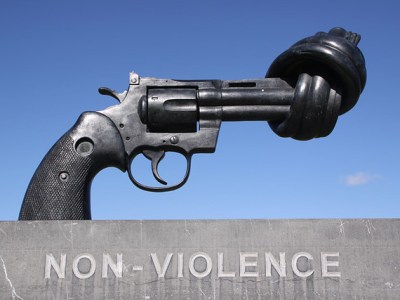
On the Killing of Charlie Kirk
The trap of violence & the suffering it creates was on full display last week. We can escape this trap through the power of active nonviolence, which resists the temptation to add more violence & searches relentlessly for just, lasting solutions to break the cycle beyond retaliation & escalation.

This Labor Day: Imagine a World Beyond Billionaires
This Labor Day, you are invited to imagine a world beyond billionaires. What happens if society reckons with questions like- ‘How much is enough?’ and ‘What makes us truly rich?’


Leave a Reply