Cross-posting the following information on a recent poll commissioned by the Quaker organization American Friends Service Committee (AFSC), whose results are especially helpful to understand in preparation for Korea Peace Advocacy in June (source 1, source 2):
True peace requires engaging those we disagree with, reflecting our Quaker belief in our shared humanity across divides. Building relationships—not isolation or violent conflict—is the only path to just, lasting peace.
When it comes to U.S. relations with North Korea and China, many people in the U.S. share these same values. That’s according to the results from AFSC’s new poll on diplomatic engagement with the Democratic People’s Republic of Korea (DPRK, or North Korea) and China. Despite the hostile rhetoric and posturing covered in the news, the majority of U.S. adults continue to support peaceful engagement with both countries—and the lifting of U.S.-imposed sanctions in many cases.
Here are the results of our fourth annual poll, conducted online by The Harris Poll on behalf of AFSC between Feb. 10 – 12, 2025, among 2,076 U.S. adults:
Growing support for engagement with North Korea
Three-quarters of U.S. adults think that the U.S. government should work with the North Korean government to repatriate the remains of U.S. service members left in North Korea following the Korean War. Most also believe that President Trump should hold meetings with the North Korean leader (70%), and that the U.S. and North Korea should collaborate to reunite Korean American and North Korean family members (69%). Half say that the U.S. should formally end the Korean War by signing a peace agreement. Support for these measures has increased since AFSC’s first poll on these issues in 2021.
Strong backing for dialogue with China
Sixty-three percent of U.S. adults agree that the U.S. should engage in dialogue with China as much as possible to reduce tensions. When asked which area should be prioritized, nuclear non-proliferation topped the list, with more than a quarter (27%) placing it higher than any other issue.
Support for lifting some sanctions
A majority of respondents agree that the U.S. should lift sanctions when they:
- Interfere with humanitarian aid or global public health (63%).
- Violate international law (61%).
- Harm individual citizens’ livelihoods (59%).
- Hinder cooperation on climate change (54%).
Now more than ever, we must work for the world we all deserve: a world where the U.S. engages peacefully on issues that matter to everyday people, at home and abroad. As our poll demonstrates, this vision is shared by most people around the U.S. Together, we can urge our elected officials to work with other countries to bridge divides, solve problems, and build a just, sustainable peace for all.
“Despite the changing geopolitical environment and rising tensions around the globe, it’s deeply encouraging to see continued support among the U.S. public for the U.S. to engage diplomatically with North Korea and China,” said Austin Headrick, AFSC’s Asia Region Public Education Advocacy Coordinator. “My hope is that the results of this survey signaling a desire to end long-standing conflicts and place principled engagement at the center of U.S. foreign policy will be heard by policymakers in Washington. People in the U.S. support engagement—our government should too.”
AFSC has been engaged with North Korea since 1980. As a Quaker organization, AFSC works to build mutual understanding and cooperation between the U.S. and North Korea. As part of that work, AFSC conducts periodic polling to capture the attitudes of U.S. voters towards engagement with North Korea, China, and the region…
“Too many polls on peace and security fail to ask about the things the U.S. public does want to see, like concrete steps towards peacebuilding,” said Beth Hallowell, PhD, AFSC’s Director of Campaigns and Communications Analytics. “Engaging with North Korea on issues such as reuniting families and repatriating service members’ remains, engaging in dialogue with China to reduce tensions, and lifting damaging sanctions are all steps the U.S. can take now to make the world more peaceful today.”
AFSC’s experts who conducted this poll are also available for interviews:
Austin Headrick serves as the Asia Regional Advocacy Coordinator at AFSC, where he promotes just and peaceful U.S. foreign policy toward Asia. Prior to joining AFSC, Austin spent nearly a decade in the field of peace education in South Korea, working with both international and grassroots peacebuilding organizations. During his time based in South Korea, Austin traveled across the region to support peacebuilding trainings with university students and civil society practitioners in China, Japan, and the Philippines. In 2023, Austin graduated from Hankuk University of Foreign Studies in Seoul with an MA in Korean Studies focusing on the challenges facing South Korean NGOs working in North Korea. Austin is fluent in written and spoken Korean.
Beth Hallowell, PhD, has worked on this poll for AFSC since its first run in 2021. Her expertise includes strategic communications, opinion and messaging research, and audience insights. Prior to AFSC, Beth focused on health inequality in the Americas. She has conducted research on the Affordable Care Act rollout in southeastern Pennsylvania and the impact of public health interventions on maternity care in rural Guatemala. Beth received her PhD from the University of Pennsylvania in 2015, where she also teaches.
The American Friends Service Committee (AFSC) promotes a world free of violence, inequality, and oppression. Guided by the Quaker belief in the divine light within each person, we nurture the seeds of change and the respect for human life to fundamentally transform our societies and institutions. We work with people and partners worldwide, of all faiths and backgrounds, to meet urgent community needs, challenge injustice, and build peace.
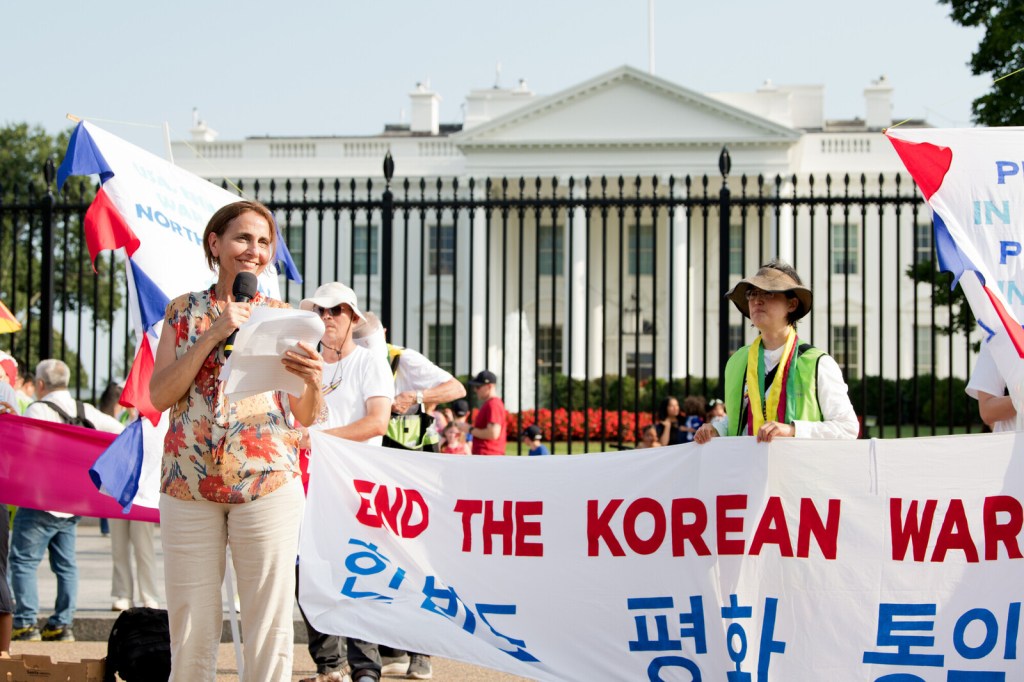
Take Action to Call for Diplomacy to End the Korean War:

Korea Peace Advocacy ✌️
It’s time to end the Korean War! Call for a peace agreement today with advocacy actions, petitions, and resources to learn about the history and impacts of Korean division and war.

 Seeds Will Grow
Leave a comment