

In our rapidly changing political environment, characterized by sweeping government funding cuts for social services, an increasing number of people in American communities are concerned about meeting their basic needs. It is time for American communities to rally together to care for one another. For this reason, I’m cross-posting this 2023 short story by Naomi Kritzer, about neighbors that learn to organize themselves to meet each others‘ needs. Scroll to the bottom of this post to hear to the story read on a podcast (source).
by Naomi Kritzer in Uncanny Magazine Issue Fifty-Five | 10883 Words
During one of the much smaller disasters that preceded the really big disaster, I met a lot of my neighbors online. I can’t remember if we set up the WhatsApp group because of the pandemic or the civil disorder or both. My Minneapolis block had always been reasonably friendly—people would take their kids around on Halloween, and I knew the names of my next-door neighbors—but everyone on the WhatsApp group got closer.
When the Internet and cell phones went down, my next-door neighbor to the north, Tanesha, built a little booth in her yard out of plywood, with corkboard inside and a roof, and painted WHATSUP on the outside, so people could leave each other messages inside. When I went in the first day to check it out, people were already posting up notes asking to swap stuff—coffee for condoms, cat food for diapers, a bike repair for a plumbing repair. The stores were empty but maybe someone on the block had what you needed.
It was weird, early on, what was still chugging away. The water stayed on, although we had to purify it. The stores nearly always had canned vegetables on the shelves, and everyone joked about how somewhere, there was a secret underground warehouse crammed with canned peas. The pharmacy a few blocks away was still getting regular deliveries of anything designated “critical meds,” like insulin, which was a relief to Tanesha. But there were also things that worked some of the time but not all of the time, like the electricity. And there were all these things that were just gone from the stores—tampons, AAA batteries, WD-40, duct tape.
I started going over every day around noon to help Tanesha “moderate” the booth, which mostly meant taking down obsolete notes. After two weeks when the Internet still hadn’t come back, I helped her build a second booth.
“We should check on people, don’t you think?” she said as I held a board in place for her to hammer. “Most of the block is using this, but not everyone.”
I hadn’t noticed, but she was probably right. Across the street, the screen door banged shut and the old guy who lived there came brusquely across the street. He was holding something that looked sort of like a power drill. “I’m Lem,” he told me. “Hold that board you’ve got right there.” Tanesha put down her hammer and the power drill thing turned out to be a nail gun, which made short work of the hammering. “Also, you want me to fix the roof on that other one, so it doesn’t drip inside when it rains.” He didn’t put a question mark on the end, which was fine, because of course we wanted him to fix the roof.
While he worked on this, Tanesha got a clipboard from her house and we made a list of the houses on the block, filling in what we knew about the residents. It was a smattering of names and a lot of phrases like “the people with the poodle” and “the ones with the generator” and “the teenager with the really loud car, although he hasn’t driven it since the gas stations all closed.”
“Should we split up the houses?” Tanesha said. “You do the east side, I’ll do the west side?”
“Okay,” I said, feeling the same dragging reluctance I’d felt as a kid selling Girl Scout Cookies—I knew perfectly well lots of people would be happy to see me, but I still hated knocking on doors and talking to strangers. I didn’t have a clipboard, so I grabbed a notebook from my house to make notes and walked down to the corner to start.
Probably three-quarters of the people on our block were already using Tanesha’s booth. With the remaining quarter, I introduced myself, told them which house I lived in, explained the booth, and then asked how they were doing. Hanging in there? Did they have food and other necessities?
The people with the generator were at mid-block. They lived in a bungalow with faded olive-green siding and a fence. Most of us didn’t have generators—we just charged up what we could during hours we had power, made do when we didn’t. This house’s generator ran during every power outage, even the short ones.
When I knocked, no one answered right away, but I knocked again and waited, and an old white guy answered the door. “I’m Alexis, from down the street,” I said. “I’m just checking in with everyone to see if they’re okay, given everything, and to let you know about this booth we’ve got set up…” He stared at me, silently, as I explained the WhatsUp booth.
“Does anyone have propane?” he asked.
“I don’t know. Someone might.”
“I’ll trade anything. Pay anything. You said I should post a sign? Can you post it for me? I can’t leave Susan.”
“I could post a sign for you, sure.”
“Can you wait—no, just come in.” He shuffled backwards to let me in the house. I eased the door closed behind me. The entryway had the close, stale air of a house that had taken seriously the instructions to close all the windows to keep out the dust and ash. “I need to find paper and a pen.”
“Clifford?” I heard a woman call. “Is someone here? Who is it?”
I followed him into the living room. An elderly woman sat in a recliner. A plastic tube snaked across her face, with prongs in her nose. She didn’t look well. “This is Alexis,” Clifford told her. “She’s going to tell people we need fuel.”
“I don’t know if anyone has it,” I said.
“Oxygen, I can also use bottled oxygen,” Susan said.
“People keep propane around. Nobody keeps bottled oxygen around,” Clifford said.
“Have you tried the pharmacy for oxygen?” I asked. “They have insulin…”
“Pharmacies don’t carry oxygen,” he said. “There are places that carry it but we used to get it delivered—I don’t even have the phone number—I can’t leave Susan and go around the city looking, even if I had a way to get around, she can’t get the generator going herself.” He pointed at a blue plastic gadget that sat next to her, which rattled like a noisy fan. “Susan has COPD. What we used to call emphysema. She needs supplemental oxygen, so we run an oxygen concentrator. Turns room air into pure oxygen. Concentrator won’t run without power, so I fire up the generator every time the power goes out. But we’re running out of propane. Don’t know what we’re going to do when we run out of propane.” He patted Susan’s hand.
“What if we could find you a rechargeable battery?” I asked.
“Problem is, the oxygen concentrator draws too much power,” Clifford said. “Drains batteries too fast.”
I crouched down for a closer look, pulling out a flashlight since the room was dim. The concentrator drew less wattage than an air conditioner, but more than a TV. “The only thing that’s gotten us this far,” Clifford said, “is that I bought the smallest generator they had. It doesn’t run our fridge or anything. It just runs the oxygen concentrator, and we only run it when the power’s out. But even so, we’re going to be out of fuel…I don’t know exactly how soon. But soon.”
“What happens then?”
“I won’t live long after that,” Susan said.
There was a shrill whistle of the carbon monoxide detector as the power came back, and the lights, air conditioner, and TV all came on simultaneously. “I’m going to shut down the generator,” Clifford said, and sprinted out the door.
“Could you be a dear and move over the plug,” Susan said to me, pointing at the concentrator.
“Move it where?” I asked, confused.
“Just the plug, to the wall outlet.”
The oxygen concentrator cut off—Clifford must have gotten outside to the generator—and almost immediately, Susan’s face turned grayish, and she started to gasp like she’d just sprinted four blocks to catch a bus. I looked around, panicked, for the wall outlet. She couldn’t even point me, but I spotted it and moved the plug over. Nothing happened. “Did I do it right? Do I need to turn it back on?” Susan managed a nod, and I started hunting around the machine for a button, terrified that I would mess something up if I pressed the wrong thing. Clifford came hurrying back in just as I found the on-off switch. Which was a completely obvious switch that I’d have found immediately if I hadn’t been panicking.
“Losing the supplemental oxygen isn’t supposed to matter right away,” Susan said, once she’d caught her breath. “It’s just I get so anxious.”
“I don’t believe you’re just anxious,” Clifford said. We sat in silence for a moment. “Anyway,” he added. “You can see why we want propane.”
I could. I absolutely could. “I’ll see what I can do,” I said, not feeling very optimistic.
Susan’s color was back, and she’d more or less caught her breath. “If you find anyone who has an oxygen concentrator they aren’t using, we could use it to fill oxygen tanks,” she said. “When the power was on. Give us another backup. I know it’s not very likely, but someone might have one in their attic.”
I nodded.
Susan swatted at Clifford gently with the magazine by her side—a ten-year-old copy of Smithsonian magazine—and said, “Can we offer Alexis a cup of coffee now that the power’s back?”
“Oh, I couldn’t possibly—”
“It’s no trouble,” Clifford said. “I’ll make a pot, you can drink some of it if you have a minute to stay.”
That trapped me, because I couldn’t let coffee go to waste, not given how scarce that was, so I sat down in a plush velour chair while Clifford knocked around in the now-well-lit kitchen. “How long have you lived in the neighborhood?” I asked.
“Oh, forty years, it must be, at this point. You don’t have kids, do you?” I shook my head. “Back, oh, early two thousands, I guess, we used to make a haunted house every Halloween and give full-sized candy bars to all the kids who made it to the end. You’d probably have been a kid yourself back then.”
“I grew up in Sacramento,” I said.
“All the way in California? Oh dear,” she said. “Have you heard from your family since all this started?”
“No,” I said, “but we weren’t really in touch before, so that’s not surprising.”
“Well, I’m certainly not going to tell you your business,” she said. “I was awfully relieved to get a letter from our son down in Kansas, though. We’ve got a big roll of stamps if you need any.”
“I guess I’d take one. I could send them a note just letting them know I’m alive. Even though that’s more likely to be a disappointment to them than a relief.”
“All the more reason to let them know,” she said. “Bring comfort to the kind and dismay to the jerks.”
Clifford brought out coffee in three little china teacups. There was a sugar bowl on the tray, but I took my cup without adding any, as did Clifford and Susan. “Thank you,” I said.
“I was just telling Alexis about our haunted house,” Susan said.
Clifford brightened up and started telling me about this zip line he’d rigged up for ghosts, and Susan told me that in the backyard they’d served hot cider out of a cauldron to parents. “I worked as a costumer at the Guthrie Theater for years,” she added. “So my witch costume was first rate.”
I laid out my list of doors to knock. “Do you know any of these people?”
About half the houses, they said things like “that’s where the Garcias used to live but they moved in, oh, must have been 2012…” but there was one house where Susan said, “oh, that’s Jeana’s house, she’s been all alone since she lost her husband two years ago, can you check on her, too?” I’d already planned to knock, but “hello, your friend Susan asked me to check on you” made it feel less weird.
My tiny cup of coffee was gone, so I set the cup carefully back down on the tray. “I’m going to go post the sign,” I said. “Thank you for the coffee. Please let me know if you need anything. I’ll try to make sure someone comes by.”
I was wrong about no one being willing to sell or trade propane. I netted four of those one-pound Coleman cylinders you attach to a camping stove, plus two partly full 20-pound cylinders like you’d use for a grill. Clifford cried when I knocked on his door with them—this would, he said, keep them running for another 40 or 50 hours. The power was generally out for two to four hours a day, so that meant another two weeks, probably, and I could watch Clifford do that same calculation even as he asked if there was anything people wanted in exchange.
“No, when people heard someone needed it to live they said I could just have it,” I said.
“I’m not so bad at fixing things,” Clifford said. “If anyone needs something fixed, someone would have to come sit with Susan in case the power went out, but…”
“I’ll let people know,” I said.
“Come in for a minute?” he said.
I almost said no but from the next room I could hear Susan’s voice call, “Clifford, you’d better not let Alexis leave without a cup of coffee,” and I decided my to-do list could stand for me to take five minutes to sit down.
“Clifford, you can repair things?” I asked, pulling out my notebook. “Any things in particular?”
“Carpentry,” he said.
I wrote that down. “We’re making a list of skills people have,” I said. “I don’t suppose either of you grew up on farms.” They shook their heads.
“I can sew,” Susan said. “I don’t imagine anyone’s going to want a fancy costume but they might like a zipper replaced.”
“You can do zippers?” I said, and made a note. “Do you need a sewing machine for that?”
“I have one. Clifford could bring it downstairs for me.”
Clifford brought out coffee for me and I sipped it.
“Clearly I should have joined Future Farmers of America, back in the day, instead of the theater club,” Susan said.
“We’ll manage,” I said. “We’re trying to figure out if there’s a way to grow food in people’s yards. Lem suggested tearing up the street and growing food there, but that got some pushback.”
“You won’t hear any complaining from us,” Clifford said. “Whatever everyone else thinks is best.”
I told them Jeana was doing fine and had been very worried about Susan. She’d have come herself to check on Susan and Clifford but she’d broken her leg back before everything started and was still having trouble walking. Getting in and out of her house, which had four steps up to the front door, was difficult. Clifford brightened at that. “I bet I could build her a ramp. It wouldn’t be up to code, but it would let her get in and out with a walker. Do you know if anyone has plywood?”
“Lem has sheets of it,” I said. “I’ll go to his house next.”
The other blocks around us had seen what we were doing and were getting more organized with swap boards and so on. We’d started comparing community needs, especially ways to grow food. We wanted a tiller, and a cultivator, to turn sod into gardens, and no one we’d found had a tiller. There was one cultivator, but it was gas-powered.
“Maybe someone in the suburbs has an electric tiller they’d trade,” Lem said. We’d started tearing up yards with spades, and it was slow going, although at least we weren’t putting buried utility lines at risk.
I offered to go. My car is electric, so I could get there. I’m white and look “respectable” unless I put on my “eat the rich” t-shirt—paranoid suburbanites were unlikely to start by shooting at me. (We’d heard stories. I sure didn’t want Tanesha taking the risk.) Once we started discussing this seriously, Frank said he’d come with me; he’s got the same “could be a suburbanite myself” vibe but he’s also huge. He worked as a bar bouncer when he was younger and you can’t tell looking at him that these days his back hurts all the time. I told Clifford not to get his hopes too high, but to give me all his empty propane canisters, just in case we found a suburbanite with a stockpile they were willing to sell.
We had a block meeting to assemble any last-minute requests. Gloria and Leah had donated four of the camping canisters and asked how Susan was doing.
“Depends on how the power holds up, but we think we probably got them another two weeks,” I said.
They exchanged looks. “If the sun was shining…” Gloria said.
The dust and ash in the air meant that it was effectively always cloudy, and the solar panels on lots of our houses weren’t doing much. Not nothing—but not much. We were all silent for a minute, because if the sun were shining, we wouldn’t be in this disaster. We’d be planning summer fun, instead of trying to figure out whether if we tore all the grass out of our yards, we’d be able to grow enough food to get through next winter.
“What about a wind turbine?” I asked. Gloria and Leah had built themselves a windmill with a generator attached, although I wasn’t sure how well it was working.
“It would only work when the wind was actually blowing,” Gloria said.
“That would be something,” I said. “If they could conserve fuel on the windy days, it would last longer.”
“A big enough battery would work,” Tanesha said.
I sighed. When I bought my electric car a year ago, I’d also looked into getting solar panels and this giant wall of batteries—you could run the whole house off the batteries, recharging them on solar (normally), and almost go off-grid, at least that’s what the reviews said. But I’d looked at the cost and had made the perfectly sensible decision to save up for solar first, fancy battery wall second. I’d asked around already, and no one else on the block had a big battery wall, either.
“I know of two people in the area, plus me, who have electric cars,” I said. “There are some models you can use as a big rolling generator but none of ours have that feature. There are ways to do it anyway, with a power inverter, but that could mean it’s not available to use as a car in an emergency.” My car was getting us to Edina today; it had gotten Khalid up to the hospital the day before yesterday, when he fell off the ladder.
“What about a bike generator?” Tom asked. “The kind you pedal.” He pantomimed.
“Those make about a hundred watts,” Gloria said, and looked at me. “How many watts does the oxygen concentrator draw?”
“Five hundred,” I said.
“Lance Armstrong would need a crew and all his drugs,” Leah said.
“Lance could dope himself silly if he were making Susan power,” I said, and then thought about how the drug shortages were getting worse. Whatever he took, he probably wouldn’t be able to get anyway.
“Okay, but what if we had five bike generators,” Tanesha said. “Each biker making a hundred watts.”
“You’d want at least ten,” Gloria said. “Humans are unreliable. Maybe twelve, actually.” She fished a notebook out of her pocket, and a pen, and started making a list. “We’d need you to trade for more copper wire. That’s tricky because everyone wants it. Probably easier than fuel, though.”
“And bikes?”
“We have all the broken ones from Jack’s garage, we can cobble together the bike generators. But we’ll need people to pedal.”
I looked at Tanesha. She looked at me. “If the Acquisition Committee can bring us copper wire, we’ll make it work,” she said. The “Acquisition Committee” was what she’d started calling me and Frank. “Bring any propane you find, though. Or gasoline.”
The roads were quiet—mostly bikes and walkers, a few city buses. Everyone, including us, had parked cars sideways to block the streets leading into their neighborhoods, then left them there, then had the gasoline salvaged or looted out of them so the cars definitely weren’t going anywhere. Traffic on the roads picked up when we got to the edge of the suburbs, even though all the gas stations were still closed. Also, in addition to the car barricades, we saw something hanging from the streetlight that for a second I thought was a body. It wasn’t a body: it was a mannequin, though, so it was definitely supposed to look like a body. It had a sign around its plastic neck saying LOOTER. So, yeah, okay. We did our best to look nonthreatening.
We’d brought samples of stuff we had in surplus, and a list of skills—like the midwife who could insert IUDs, and the people who’d worked on farms and could help with figuring out how to tear up yards and grow food there. “Why would we tear up our yards?” asked the first man we spoke with. “I just had that sod put down last year!”
“I mean, you’re going to want enough food…”
“Things are going to be fine. Everything will be back to normal in a month.”
“Okay,” I said. “Well, in that case, if you’ve got an electric tiller you’re not using, we can pay for it in gold.”
It was a very productive, if sort of distressing, trip—we found people happy to take gold in trade for a bunch of useful things, including a spool of heavy copper wire that they’d taken off the bodies of some looters and stuck in a garage. Several suburbanites clearly had a large supply of fuel, but no one wanted to trade any away. Frank was happiest about the tiller, but I was thrilled with the wire—in addition to the plan with the bikes, we could use this to make multiple wind turbines.
Back in our own neighborhood, Frank handed off the tiller and Lem went to work with it right away. I took the wire over to Clifford and Susan’s garage. Clifford had used it as a workshop when he was younger, so it was insulated and reasonably pleasant, but then he’d slowly filled it with junk. Leah was supervising a team of teenagers who were clearing out the garage; Gloria was sorting things out and sending them to different garages around the block we were using as salvage bays or storage. Clifford popped out periodically to explain that a snow blower would probably work again with a new belt or maybe a replacement flywheel; Gloria sent that to the garage where they’d be building turbines, because a big snowblower auger could be turned into wind turbine blades.
Meanwhile, people were bringing over bikes. There were a dozen broken bikes from Jack’s garage, another dozen semi-functional bikes from other people’s garages, and four actual stationary bikes people brought over when they heard about the project. Gloria’s team worked on cleaning off rust and getting everything lubricated.
Clifford and Susan’s garage would have held two cars. Emptied out, it looked enormous: I looked at the workbench on the far wall and imagined how it had looked to Clifford when they’d bought the house years ago, a space filled with potential. “We need more light in here,” Gloria said, looking around. “But we’re going to need light that doesn’t draw much power, LEDs or something.” I opened a box marked CHRISTMAS and pulled out some strings of Christmas lights to run around the edge of the room.
If we’d had no power at all, we couldn’t have done this—we’d have needed too many people, for too many hours, to handle it. But the power was still on for part of the day, every day. Most of the day, even. We just needed to fill in the gaps.
The first gap we needed to fill in was the time to change things over—from city power to wind power, or wind power to bike power. Gloria had turned up a couple of big rechargeable batteries and set them up in Clifford and Susan’s living room.
“Why do we need three of them?” Susan asked.
“Because humans are unpredictable,” I said. “With bike power, they’ll be sending power in, but if everyone starts pedaling slowly at the same time, we want something to even things out and make sure your oxygen concentrator is still running. Also, if you exhaust one during the transition, we want you to have extras so you can wait until the power’s coming from the city again to recharge the one that’s used up.”
If the wind was blowing, the windmill would take over generating power. But sometimes, the power would fail and there’d be no wind. Gloria set up a car alarm to go off when that happened, and that would be the cue for a squad of fit youngsters (mostly teens from the surrounding four blocks) to come running to pedal the bikes until the power came back on. If it was a long power outage and people got tired, we had a secondary set of signals to bring in replacements.
“Are people really going to do this?” Susan asked when I explained it to her.
“We can pay them,” Clifford said. “How much is fair? I never even hired someone to shovel my snow because I didn’t know how much to offer that would be fair. I don’t think we have anything people would want for trade.”
“Superlative cosplay costumes?” Susan muttered.
“People have been working on the food-production project for free,” I said. “Let’s see if we can get volunteers. You still have a stash of propane, if this doesn’t work out.”
I had actually thought we’d need to come up with a way to pay people—after the first week, anyway—but it turned out to be exactly like ripping up yards to plant potatoes, people were willing to just do it. No one wanted to be responsible for doing all of it, but pedaling one of a dozen bikes for an hour? Or a half hour? Lots of people were willing.
It did help that Hong, who lived next door to Clifford and Susan, had a backyard hot tub in a gazebo, and anyone coming off bike-pedaling duty could hop in for a quick soak. You couldn’t turn it into a whirlpool unless the power had come back, but the water was always at least comfy.
“Can you please tell people to come inside sometimes so I can say thank you?” Susan asked when I checked in after the first week. Tanesha’s daughter Jasmine was sitting on an ottoman pulled up next to Susan’s recliner, with a basket of yarn in her lap and a crochet hook in her hand; apparently, Susan could make amigurumi, those adorable crocheted stuffies, and was teaching Jasmine the tricks of the trade. They were making little crocheted mice.
“They don’t want to be a bother,” I said.
“We can make them coffee. Or lemonade.”
“We can make lemonade for the first ten,” Clifford said. “Then we’ll be out of either the lemon juice or the sugar.”
Clifford had been going out to the garage to say thank you to the people pedaling, but Susan couldn’t, since she was stuck in the house with her oxygen concentrator. This was allegedly a “portable” model and what that seemed to mean was, you could roll it over to the bathroom when you had to pee. “How did you ever leave the house, before?” I asked, and then wondered if the answer was, she didn’t? I didn’t remember ever seeing her.
“Bottled oxygen,” Susan said.
“Do you think you could teach more people how to make those?” I asked, pointing at the crocheted mice.
“Oh, they’re so easy,” Susan said. “Definitely, anyone who wants to learn.”
“For kids younger than Jasmine?”
She thought that over. “I think I was six when I learned crochet,” Susan said. “Not little creatures back then, though, my aunt taught me how to make a potholder. It would depend on the kid, though. Some little ones are all thumbs.”
“You’re thinking about Kalia, aren’t you?” Jasmine said, and turned to Susan to explain. “Kalia wants to help with everything but mostly she gets in the way. And her parents are very busy. Her mom’s a nurse and still goes to work and her dad’s been helping with the block farm. And no one’s really had time for her. She’s seven.”
“Oh, in that case, bring her over,” Susan said. “I’ve got a whole closet full of yarn and if I can’t teach her crochet, I think I’ve got one of those old plastic knitting looms around, I’ll teach her how to make hats. We can give them to people when they come in so I can say thank you.”
By early May, medications were getting harder to get.
The rule was supposed to be that “life-sustaining” medications were prioritized, which everyone agreed made sense. But that turned out to exclude most of the psychiatric meds, no matter how important they were. You could still buy cigarettes, so Frank, who’d quit smoking years ago but now couldn’t get a prescription he needed, went back to smoking as a substitute.
“Send him in to talk to me,” Susan said, fuming, when she heard.
“He won’t,” I said. “He said he doesn’t want to carry the particles on his clothing into where they might get into your lungs.”
“Horse hockey,” she said. “He just doesn’t want the scolding he deserves.”
Frank said it couldn’t be any worse for him than breathing the air all day, which was definitely horse hockey—the damage was cumulative—but given that he’d privately given me the list of drugs he needed, and I hadn’t found any of them, I was inclined to just let him be. If cigarettes kept him halfway functional, let him smoke. Away from Susan.
Clyde also gave me his list, and cigarettes weren’t going to cut it as a substitute. He looked extremely uncomfortable as he handed it to me. “I’ve done really well for years,” he said, as I looked it over. “But back when I was about twenty-two I got hospitalized because the walls were talking to me. I usually take aripiprazole, but either of these other two will work. I took Zyprexa for years and only went off it because I started developing sugar diabetes.”
“That wouldn’t be good, either,” I said, thinking about Tanesha’s worries about insulin and blood testing strips.
“Oh, I know.” He laughed a little. “But temporarily, you know, it’s an option. The gabapentin is for anxiety.”
“The store’s out of gabapentin?” I said, dismayed.
“Nah, but they prioritized the folks who need it for pain. I get that, I do, but they offered me benzos and…I really don’t want to take benzos.”
“I’ll see what I can do, Clyde,” I said, and put out the word.
Two days later, Pang stopped by my house with a giant shopping bag and handed it to me. I peered inside and just about recoiled when I saw the unopened boxes of both Abilify and gabapentin. “You didn’t rob a pharmacy, did you?” I said.
“As if I’d have found the Abilify if I had,” she said. “No, I was doing an IUD for a woman over by the park, and she told me her mom died a few months ago and she had all these meds left over. There’s other stuff in there, too, I just figured I’d bring you all of it.”
“Thank you so much,” I said.
“I’m going to start asking people for leftover stuff every time I’m at someone’s house,” she said. “No one around here ever throws anything away. There are three half-finished packs of antibiotics in there! I mean if you’re not going to finish your antibiotics like they tell you to, at least throw them out! But nope.”
There were a couple of people with drugs that had to be refrigerated, and as summer got into gear, we started using Lem’s extra deep freeze, which was enormous, to do nothing but store plastic sacks of ice cubes, so that if we had an extended power outage they’d be able to pack everything into a cooler full of ice.
In late July, a huge storm hit Minneapolis.
We had some warning, both from the extremely ominous clouds and the radio, and made the quick executive decision that we wouldn’t call people to pedal until the storm passed—the storm should be providing plenty of wind, and if winds were bad enough to knock down the turbine, they were bad enough not to send people running through the storm. Clifford had a stock of propane, and this would be a good time to use it, if he needed to.
The rain came in sheets, buffeted by the wind; I listened to it rattling on my roof. I paced around in my living room, peering out at the dim afternoon and hoping the rain didn’t wash away all the crops we’d planted in the yards we’d dug up, hoping no one’s basement flooded, hoping the power stayed on. I wished I’d gone over to Tanesha’s to wait this out.
When the power went out, I went upstairs to try to spot Clifford and Susan’s house, to see if the wind turbine looked like it was working. There were too many boulevard trees and too much rain for me to see anything. I paced around, thinking about how “we don’t want people running around outside in the storm” was still a perfectly sensible decision and then put on my shoes and stepped outside.
I didn’t bother putting on a raincoat, because I was just going to have to accept I’d be soaked to the skin. The turbine had been knocked down, and I could see Clifford plus someone in a yellow raincoat bending over the generator. I waffled for a minute about whether they could use my help or if I’d just be in the way, but then they both straightened up and I saw Clifford go back into the house and the person in the raincoat dash back across the street. They’d gotten the generator on. I went back inside and closed the door on a titanic crack of thunder and what sounded like a tree splitting in half.
Morning arrived, but not power. I went out, in dry clothing and damp shoes, to have a look at the damage. There were trees down everywhere, all the nearby streets were blocked, and when I walked up for a closer look at the tree blocking the big through-street I saw power lines that had been knocked down—our neighbors to the north had put out orange hazard cones to keep people away from the wires.
Clyde worked at the hydro plant on the Mississippi near downtown, and as I was gawking at the power lines he came up next to me, his work clothes on, carrying a rucksack. “Don’t touch that,” he said.
“I won’t,” I said. “Are you on your way in?”
“Yep. Going to have to walk it, the bus can’t get through the downed trees. Can someone feed my cats if I’m not home tonight by eight?”
“You bet,” I said.
Tanesha was already organizing people to go clear what we could. Five people had cordless chainsaws—the real trick was going to be finding all the charged-up batteries that could be swapped in, and what we were going to do once those were used up. In the distance, I could hear other people’s chainsaws, and a generator that wasn’t Clifford and Susan’s.
Clifford and Susan’s generator was now off: pedalers had arrived and taken over, and Leah and Gloria were putting the wind turbine back up. Clifford was sitting on his front steps, watching them work. “Kalia found one of those turbine blades stuck in the shrubs next to Abdi’s house,” he said. “We probably should have taken it down before the storm.” He glanced at me. “We used up a lot of the propane.”
“I know,” I said. “I’m sorry.”
He shook his head. “No, I’m not saying anyone should have come to pedal! Someone might have gotten brained by a flying turbine blade! I mean…” He rubbed his palms against the knees of his jeans. “Our retirement wasn’t supposed to be like this. We were supposed to travel around, see all the places we never had time for. Susan wasn’t supposed to get sick. All this…” His voice cracked as he waved at the hills of potatoes in his yard, the wind turbine, the branches. “This isn’t what it was supposed to be like.”
Jasmine popped out of the front door. “Clifford?” she said. “Susan’s asking for you.”
Clifford stood up. “Excuse me,” he said, and went inside. When I went in a few minutes later to get Jasmine, his anger was gone, or at least well-masked again. “Lem was here earlier looking for a saw vise,” he said. “Can you let him know I found mine?”
“I will,” I said.
The radio said crews were working around the clock to get roads cleared and lines back up, but it could be days—at least they weren’t saying weeks—until everyone’s power was back. That meant we were going to need a lot more pedalers than usual. Tanesha sent Jasmine and Kalia around to the houses on adjacent blocks that weren’t usually part of the pedaling corps, to see if anyone was willing to volunteer. This brought in a new group of pedalers as well as a couple of people with handsaws and some willingness to tackle the downed trees.
We also got a naysayer who’d previously been ignoring the whole project and now wanted to complain to Tanesha about what we were doing. “It’s very sad and all, but it’s not like the lady who needs oxygen is going to get better,” he said. “You’re just delaying the inevitable.”
Tanesha gave him a narrow-eyed look. “You delay the inevitable every time you eat lunch.”
“That’s different.”
“It’s really not,” she said.
I thought of Clifford’s furious it wasn’t supposed to be like this and felt a surge of my own anger, enough that I let Tanesha finish the conversation and then just muttered “asshole” as the guy stomped off down the street. I felt like if I started screaming at him, I might never stop.
The wind picked up that evening and the repaired wind turbine gave everyone a break. We used the other turbines on the block to charge up the batteries for the chainsaws. We also checked Clifford’s stock and decided to use the generator for a few hours during the hottest parts of the afternoon the next day. We had everyone with a wind turbine making ice if they could, to keep the coolers stocked for people with perishable medications.
After four days, the power came back. As did Clyde, who looked exhausted but had at least been able to ride the bus home through the now-cleared streets. Jasmine and Kalia had been over at his house every day to feed his cats and left him a batch of cookies they’d baked in a Dutch oven. We’d turned all those downed trees into firewood—figured we might as well.
Summer went by. A lot of what we’d planted didn’t grow well, for the same reason the solar panels weren’t much use—the lingering ash in the air clouding over the sun. We got a lot of potatoes, though, and some other root vegetables that would tolerate shade. We’d planted in what would be “full sun,” normally, and there were days when we could tell the sun was out, because there were shadows on the ground despite the gray sky. Valeria, who’d been a Master Gardener at the University Extension and appeared to have magical powers over plants, gave all the potato plants pep talks, telling them to just do their best, and that seemed to help.
Valeria also knew the best way to set up a makeshift root cellar in a garage, for all the potatoes, carrots, turnips, and beets. We canned some of the green beans, but not a whole lot, because canning supplies were as hard to find as anything else.
Unfortunately, Valeria’s magic wasn’t able to deter garden scavengers: we put up chicken wire to keep out rabbits, but the urban deer were getting increasingly brazen. They jumped over the first fence we put up, barreled straight through the second.
In the twilight hours one August morning, I woke suddenly to a loud noise. I was used to being roused by the “pedalers needed” alarm, but the power was on. Also, it had been just one loud noise, I wasn’t hearing the whoop-whoop-whoop of the car alarm. This was odd enough that I put on my bathrobe and went outside, at which point I found Lem, a dead deer, and a ferocious argument already underway.
Lem, apparently, had loaded his hunting rifle, come out in the predawn quiet, and shot one of the deer foraging in the garden. “Look,” he said, exasperated. “The problem is, they’re eating our food. Good news, though, deer are food. Venison jerky has more calories than green beans anyway.”
“Lem, you cannot be shooting off a gun right by where we live,” Gloria said. “You can not.”
“No one’s up at five! Anyone who is up, isn’t outside! Also, those deer are shameless. I got ten feet from her before I fired. Sure wasn’t going to miss at that distance.”
Tanesha had come out of her house about a minute after I came out of mine, and everyone paused and looked at her, like they’d agreed it was up to her what happened next. She looked at the deer, at Lem, at Gloria, at everyone else, and said, “Lem, do you know how to field dress this thing? Get it somewhere it won’t make the little kids cry and get started on processing it, we’re not letting it go to waste. Meet back in an hour, or whenever you’re done.”
The previous day had been cool, a little taste of early fall, but today was hot again, and we set up a couple of wading pools and sprinklers in the street for the kids to play in while we had our meeting. “It’s not that we object to hunting,” Leah said, quickly, as soon as everyone sat down. “We just don’t want it happening so close to people’s houses.”
Lem snorted. “I’ll just drive up to my brother’s cabin, then, and let the deer keep eating the potatoes.”
“They were eating the green beans—”
Tanesha managed to cut that argument off before it got any further. “Leah, I get what you’re saying, but he’s right—there’s hunting, and there’s pest control, and he could go somewhere else to hunt but that won’t do much for the pest control.”
“I think the deer herd lives over in the cemetery,” Valeria said. “Maybe Lem could go there?”
The cemetery was easy walking distance but still kind of outside our particular part of the neighborhood. We all paused, thinking about who we knew between our block and the cemetery, and Valeria added, “Everyone’s having trouble with those deer, and we could promise them jerky.”
“There’s still a Department of Natural Resources,” Lem said. “Game wardens. Police. I knew you folks wouldn’t turn me in for taking this one. I don’t know about the folks by the cemetery.”
“My gardener friend over there, she’d be all for it. She’ll want to know if you can do the bunnies while you’re at it.”
“What about her neighbors, though? And their neighbors?”
“Valeria, take Alexis and the two of you see what you can find out from the people right by the cemetery,” Tanesha said. “In the meantime, Lem, no more shooting off guns by our houses.”
“What if someone shows up trying to loot stuff?” Lem asked.
“No deadly force against property crimes, either,” Tanesha said. That set off another round of arguing. A lot of my neighbors had guns, it turned out—that probably shouldn’t have surprised me as much as it did. The number of arguments in favor of deadly force against property crimes probably shouldn’t have surprised me either, given how worried everyone was about the food supplies.
I just listened, thinking about the suburbanites who’d strung up a mannequin, and how much I didn’t want that to be us. Eventually the less gun-happy more or less won the argument: we’d defend ourselves with force if it came to that, but not guns, not without another discussion, not unless someone was actually threatening us with violence.
The cemetery neighbors turned out to be wildly enthusiastic about a discreet deer hunt, especially with the promise of venison. They stood lookout as Pang’s husband Bee went with Lem to stalk and shoot the herd. We split the meat, enjoyed some venison burgers and venison chili, and turned the haunches into jerky to save for winter.
One fall day I passed Susan’s yard and she was sitting out front in a lawn chair, her oxygen concentrator plugged in to a long heavy-duty extension cord. She had a giant bushel basket of tiny semi-wormy apples, a dozen little kids, Jeana—who was still using her walker—and Gail, a woman from the next block who walked with crutches. I went over to say hi, and saw that they had rounded up vegetable peelers for each child, and had the kids painstakingly peeling the tiny apples. The adults cut them carefully into rings, and then the youngest children in the group were spreading them out on cookie sheets. I went over for a closer look. “That’s amazing,” I said.
“We’re peeling off all the bad spots,” a little boy informed me excitedly. “Peeling them very, very carefully and we’re making dried apples and I’m being very helpful! Would you like an apple? I can find you one without any bad spots!”
“That’s a good idea,” Susan said. “Why don’t you see if you can find Alexis a nice apple from one of those big baskets by the fence.” He zoomed off and she turned to me to explain, “Gail has an apple tree.”
“I can’t even remember what sort of apple they told us this was when we bought the tree,” Gail said. “We had this vision of homegrown apples that looked like the ones from the store. Turns out orchards mostly use a ton of chemicals and if you don’t, everything from birds to squirrels to moth larvae get into them. Plus you need to get up on a ladder and thin them when they’re tiny if you want them to grow to full size. Which Kent even did, this year, but they still stayed small, probably because there was so little sun.”
The little boy came back with an apple, and I borrowed a knife to cut it into wedges for myself. The slices were delicious, sweet, and crisp.
“Unblemished apples actually keep pretty well,” Jeana said. “But I’m not sure there are any unblemished apples, so we’re turning them into rings to dry. It’s something the kids can help with, too.”
“Are you just making the rounds?” Susan asked. “Or are you looking for something? You’ve got your clipboard.”
I looked down at my list. “Tanesha is thinking about winter,” I said. “Power outages will mean furnaces can’t run.”
“I have a gas furnace,” Jeana said. “Are they thinking there won’t be natural gas?”
“It’s a gas furnace, but it won’t run without electricity because of the blower,” I said. “It would be bad if it did, actually, because carbon monoxide would build up.”
“Mine runs without a blower,” Susan said. “Clifford and I have a gravity furnace, it’s an older style. Looks like an evil octopus in the basement. It runs without electricity.”
“It looks like an evil octopus?”
“I don’t know how else to describe it,” Susan said.
“I always thought they looked like space aliens,” Jeana said. I went to find Clifford for a basement tour.
The gravity furnace had an enormous barrel-shaped central unit with similarly enormous vents sprouting off it in all directions. It did, in fact, look like a giant evil octopus. “I really don’t know anything about these,” I said.
“We always meant to replace it,” Clifford said. “They’re not very efficient but having it taken out and replaced would be so expensive, and they last forever. No moving parts.”
“Are you cool with people showing up to spend time in your house this winter?” I asked.
Clifford laughed, and that somehow turned into him leaning against a wall and wiping his eyes and nodding.
We harvested the potatoes and turned backyard tool sheds and cold corners of basements into root cellars. We identified houses to work as shelters during cold snaps without power—there were two other gravity furnaces, two houses with super-efficient heat pumps, and a couple of well-insulated homes with gas furnaces so we’d only need to power the blower. Shelter houses also needed enough space inside for visitors and owners who weren’t dicks. (I love my neighborhood, but we do have our share of dicks.) Shelter houses got a turbine if they didn’t already have one, and Gloria sent around this group she and Lem had trained to caulk all the windows and build a vestibule so that when people came in all the heat didn’t go rushing out. Susan made decorative WELCOME banners the shelter houses could hang out so everyone would remember which ones they were.
In early November, a government convoy started coming through on the big main street once a week to distribute relief supplies. The buses got less reliable, and I started giving Clyde a ride to and from work when I could. Sometimes I couldn’t—during brownouts, there wasn’t enough power to charge up my car—and he walked to the plant.
The houses with the heat pumps also had solar panels. So did several other people on the block. Predictions said that enough ash should be out of the air by mid-winter that we’d be able to get power from those again—although those predictions were making a lot of assumptions and I sure didn’t want to count on that. I didn’t want to count on those convoys continuing, either. In the meantime, we pooled the canned goods from the convoy and passed all the canned beans along to Diana, who had a severe nightshade allergy and couldn’t eat potatoes. This was a lot of beans, way more than fit in her cupboards, and we stacked them up in her living room and made jokes about the Great Wall of Legumes. We were glad for that, though, because then the convoy didn’t come for three weeks.
After two weeks without a convoy, the suburban neighborhood we’d visited in early summer sent over a delegation wanting to buy food. They started out hoping to buy with money, but when that produced no interest, they upped their bid to fuel. That sent us back to run some calculations—how much did we have? How many government relief convoys did we expect to see, based on the rumors we’d heard? We agreed to a trade, potatoes for propane, because it would be good to keep the option of the generator open, especially if we had another prolonged outage.
“Where do you suppose they got the fuel?” Tanesha asked me when they stepped outside for a private conversation of our offer.
“Either they had a hoarder, or they hijacked a fuel truck,” I said. “Do you think a bunch of rich yuppies could pull off a fuel truck heist?”
They came back with the propane tanks and tried to make us sweeten the deal in that obnoxious way people sometimes will, then left with their potatoes and their bad attitude and went back to the burbs.
“I have a bad feeling,” Tanesha said. “Let’s add some folks to the people watching overnights for a bit.”
Tanesha was right.
I was standing watch at the south entrance to the neighborhood when the attack came. We used walkie-talkies for communication, although they were the kind some guy bought for his hunting blind years ago and were not great. Mine went off with a squawk, and I heard the word “west entrance—” over the static before it went silent.
I set off the car alarm. We’d started out using the car alarm to summon people to generate power, but over the months we’d come up with a set of signals in addition to the standard “pedalers needed” alarm. We had a fire alarm (we’d actually saved Luke’s house by running with fire extinguishers and a garden hose, which was a damn good thing because re-building a house right now would be a non-starter) and also a generic “all hands! Emergency!” alarm.
“West entrance!” I shouted to everyone who headed my way, and the word got passed. Although once the bulk of the neighbors headed in that direction, others stayed to reinforce my spot, in case the west entrance assault was a diversion.
It was not. We were dealing with a coordinated attack but not an especially sophisticated one. Their plan was just “get in, grab stuff, get out,” and they’d assumed we wouldn’t be able to respond quickly enough to stop them. Back in the spring, they’d have been right! But for months now we’d been drilling a fast response to alarms, not because we were rehearsing for an invasion, but because we were making power for Susan. The interlopers never had a chance. Most of them ran away but Keith got one in a headlock and another one, by sheer bad luck (for him) tripped and went down and broke his own ankle. No one had even touched him.
Despite the “no deadly force against property crime” rule, Lem and Bee both had guns with them, but neither gun came out of its holster. The guy in the headlock flailed around trying to pull something out of his pocket, but Clyde just slapped his hand away. He turned out to have a gun rattling around loose like a set of keys in one pocket, and pepper spray in the other. We confiscated both. The one who broke his ankle had a gun in a holster where we could see it but Lem barked instructions at him and the guy didn’t even try to draw. It turned out to be an air pistol.
We hauled our prisoners into Keith’s house (I think on the theory that Keith had created this problem by catching someone) and someone went to get Pang to splint the klutz’s ankle. Once we had them in good light we could see that they were teenagers, which explained a lot. Stupid white boys from the suburbs, we were pretty sure, and this was confirmed by the injured one as he ranted about how he knew this was a bad idea, he told everyone this was a bad idea, he didn’t even want to come along and had come just to keep them out of trouble. They were not actually from the suburb we’d traded with, but somewhere west of there. They’d heard we had a surplus of food and figured they’d swoop in and supplement their own dwindling supplies.
“I think we should ransom them,” Keith said.
Tanesha shook her head. This turned out to be mainly a semantic quibble. “Fine them,” she said. “Their parents can pay for the damage they did.” The boys had kicked in the side door of someone’s garage before the neighbors had stopped them.
The alarm went off again and there was a brief moment of oh no what now and then we realized it was just a call for pedalers. Everyone was awake, despite it being the middle of the night, and most people were still buzzing with adrenaline, so those slots would be easy to fill.
“What is that?” asked the uninjured boy. Kyle. He hadn’t told us his name, but the injured one had sworn at him a bunch, so we’d picked it up.
“It means we need people to run the generator,” Tanesha said.
“See,” the injured one said, furiously. “They have a generator. We’re lucky we didn’t get shot.”
“Shut up, Jake,” said Kyle.
“I mean, they’re basically paramilitary over here…”
“We run a generator to keep a lady breathing,” Keith said.
Both boys stared at him in open disbelief.
“Do you want to see it?” Tanesha asked, standing up. “Maybe it’ll give you some ideas to take home to your own community.”
Getting them over there was kind of a production. Even splinted, Jake couldn’t walk on his injured ankle, so Leah went and found a knee scooter from the garage full of “could come in handy” stuff that Hawa kept organized. Kyle presented the opposite problem—he could just run for it, and might outrun us if he tried. Keith wound up taking his shoes.
It was a cold night, but the generator station was warm, because it was well-insulated and the pedalers had been at it for a while. There were twelve people on the bikes, twelve hanging out on the sofas at the edge of the room for rest breaks. The room was equipped with LED string lights, a meter that let them track whether they were putting out enough power, and a bunch of miscellaneous posters and pictures that regular pedalers had put up. It had started with this nice photo of Susan, which Clifford had hung up early on. Then someone added a picture of his grandma in another state, who he hadn’t heard from in a while and was hoping was okay, and then someone else put up a poster of mountains with blue sky. At this point, the walls were very well decorated.
The people on the couches were relaxing and waiting their turn, with two of them—Hakeem and Galen—cooperating to come up with rhymed lyrics about fighting off the suburbanites. Everyone was laughing. They trailed off as we came in. “What’s up?” one of them asked, nervously.
“Kyle and Jake wanted to see our generator,” I said.
Hakeem stood up. “Yeah,” he said. “We generate electricity to keep an oxygen concentrator running.” He walked over to the wall to point out the photo of Susan.
“Is she your doctor or something?” Kyle asked. This question was met with baffled silence. “An engineer? What makes her so important?”
“She teaches crochet,” someone from one of the bikes called. “Those little guys up there.” The décor included a shelf of amigurumi.
“No, seriously,” Kyle said, laughing. “I don’t get it.”
Hakeem was one of those teenage boys who was all limbs, and he stepped up to loom over Kyle, who shrank back. “Susan,” Hakeem said, “is a member of our community.”
Kyle stopped laughing and swallowed hard. “Do you want us to pedal? Well, me to pedal. Jake’s injured, he can’t do it.”
Hakeem loomed a few seconds longer. “No,” he said. “No one wants you to pedal. We want you to go home to your suburb and tell your buddies not to mess with us.”
I’d imagined we would have to haul these boys back to the suburbs ourselves, but by morning, their parents were standing at the edge of our neighborhood looking indignant. When Tanesha came out without their sons, and said they’d need to pay a fine to cover the damages they’d done, they angrily threatened to call the police, which made all of us laugh. Then they only wanted to pay the fine for Kyle, and not for Jake, apparently because Kyle’s parents were important and Jake’s weren’t, although the fact that Jake had fallen down and hurt himself seemed to play into it. Tanesha made it clear they were a package deal, no discounts available if you only wanted one, and after a bit more grumbling, they forked over the fine—a 20 lb propane tank, almost full.
Early in the morning on the first day of February, Jake showed back up.
He arrived at dawn, more or less. Alone. Limping a little bit, because it had been a long walk, and shivering, although the cold snap we’d been in was easing off. Tanesha threw her coat on over a nightgown and came out. “What are you doing back?” she asked.
“I want to join you,” he said.
“What do you think you mean by that? We’re not the Army. You can’t just sign up.”
“I want to live here,” he said. “I promise I can work. When I don’t have a broken ankle I can work really hard. I can pedal, I can dig, whatever you want me to do I can do.”
“Where do you think you’re going to sleep, son?” asked Lem.
He looked miserable. “I don’t know. Maybe someone has a couch?”
Lem, Tanesha, and I looked at each other and Tanesha said, “It’s too cold to stand around chatting, let’s get you inside somewhere to figure this out.”
The lights were on in Susan and Clifford’s house, though their WELCOME banner was tattered by the wind, so Tanesha and I knocked and went in with our new guest. There’d been a power outage overnight but the sharp wind had all our wind turbines pumping out power, no pedalers needed, and the city power had come back about a half hour ago. Clifford was puttering around in the kitchen and Susan was awake, because she called, “Who’s here? Come say hello!” as soon as we closed the door behind us, and added, “Clifford, make some coffee!” without waiting to see who it was.
“Don’t waste your coffee, it’s me and Alexis with an uninvited guest,” Tanesha said, humor in her voice.
“Uninvited…?” Clifford said, coming out of the kitchen and looking Jake up and down. “Where’d he come from?”
“Suburbs,” Tanesha said. “He’s looking for a place to stay.”
Jake took a deep breath. “I can pedal, I can dig, I can cook and wash dishes, I can shovel snow. I’m not great with tools but I can follow directions.”
“Why did you come here?” Tanesha asked, exasperated.
“Because I want to live somewhere that people take care of each other,” he said, his voice cracking.
Susan waved him to her side and took his hand. “Don’t worry, kid,” she said. “They’re softies here. They won’t throw you to the wolves.” She plucked a tissue from a box on her side table and handed it to him to wipe his eyes. “Welcome to the collective. We have a guest bed, upstairs. Or at least we did.”
“We gave that bed to Lem, I can’t remember why,” Clifford said. “There’s space up there, though, and I’m sure someone has a bed they could bring over…”
“I don’t need a bed—”
Someone pounded on the front door and my first thought was that Jake’s suburb was back to reclaim him, but it was Lem’s voice, and from what we could hear he sounded gleeful, not worried. Tanesha went to open the door and he’d already gone running down to the next house, but his voice carried back to us. “Blue sky,” he was yelling. “Blue sky!”
I looked up. There was a patch of blue—just a tiny one, but a patch of blue—and the sunshine was streaming down, cold and bright. “Come out!” I shouted over my shoulder and ran across the street to knock on more doors and bring people out to see. When I looked back, Clifford had gotten Susan, haltingly, as far as their front doorstep, with Jake behind her lugging her concentrator. They were looking up at the sky, at the break in the not-quite-clouds, squinting in the sunshine, that same expression of wonder on their faces that I was feeling.
When I returned to Susan and Clifford’s house, Jake was earnestly trying to explain to Tanesha that seeing the pedalers had made him realize there was a better way. “You’re in,” she said. “It’s fine. We’ll find you a spot. Let’s just bask in the glory of the knowledge that spring might actually come this year. Blue sky.”
Author Note: I want to express my deep gratitude to Haddayr Copley-Woods, Betsy Lundsten, Kristy Anne Cox, Marissa Lingen, and Sigrid Ellis, who generously offered feedback on various iterations of this story.
(Editors’ Note: “The Year Without Sunshine” is read by Erika Ensign on the Uncanny Magazine Podcast, Episode 55A.)

Naomi Kritzer is a science fiction and fantasy writer from St. Paul. Her fiction has won the Hugo Award, Edgar Award, and Minnesota Book Award. She has a spouse, two grown kids, and three cats (the number of cats is subject to change without notice). You can find Naomi online at naomikritzer.com or on Bluesky as @naomikritzer.bsky.social. Her latest book, Liberty’s Daughter, is coming out in November.
MORE INSPIRATION & MUTUAL AID
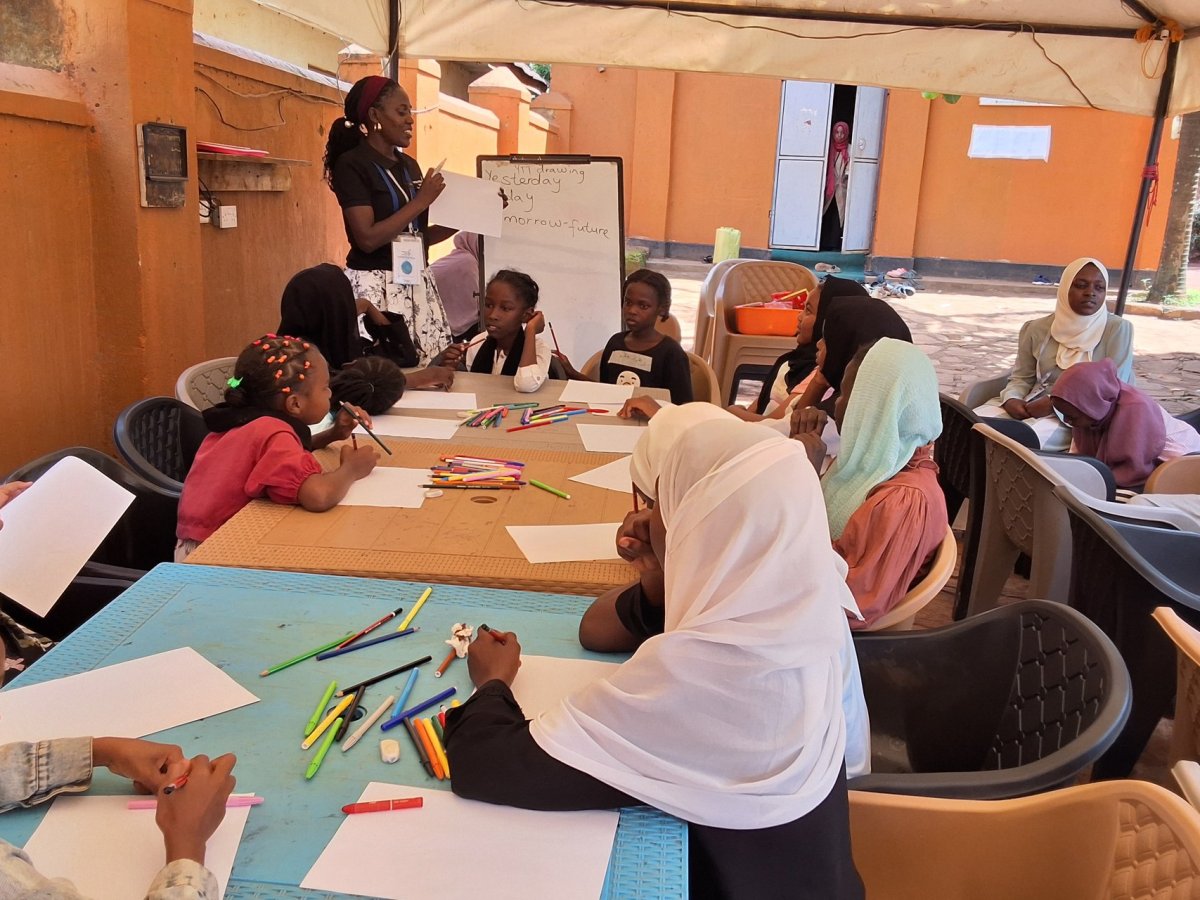
TRAID’s Child Safe Space Program
Trauma Rescue Aid currently runs a Child Safe Space Program for refugee and internally displaced children affected by the war in Sudan.

Dreaming
A vision of the world that could be. A vision of the world we can build together.

TRAID’s 2025 Report
Trauma Rescue Aid is a Sudanese-refugee-led, grassroots organization serving the physical & mental health needs of the Sudanese refugee community in Uganda. This is a report on our 2025 activities.
Something went wrong. Please refresh the page and/or try again.

 Seeds Will Grow
Leave a reply to Advocacy 101 – Seeds Will Grow Cancel reply