
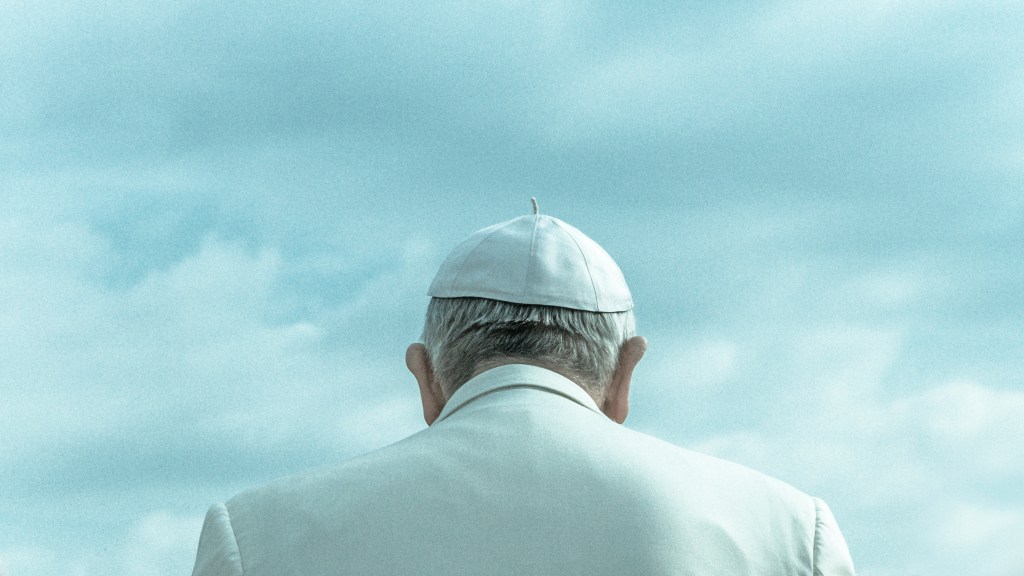
Cross-posting this great article by Ken Butigan about Pope Francis’ work to bring the logic and teachings of nonviolence back to the center of an institution that has often ignored Jesus’ nonviolent teachings. Originally posted on Pace e Bene’s Campaign Nonviolence blog (source).
Pope Francis Opened Space for the Nonviolent Shift
Ken Butigan
April 21, 2025
It is said that when St Francis of Assisi died, the grief his followers felt was gradually transformed into profound gratitude and joy as they gathered to process with his body from the Porziuncola – the little chapel he had renovated at the beginning of his ministry – to the church of San Giorgio in Assisi.
As one of his biographers puts it, “Throughout the night, the people of Assisi, and large parties from neighboring towns and villages, made their way…by the light of torches and flares. The mood of the friars was so infectious that the whole crowd took up their chants of praise and thanksgiving. Thomas of Celano, much affected by the combilation of lights, jubilation and singing, saw it as a ‘wake of angels.’”[i]
Now, almost 800 years later, the pope who was the first ever to take the Poor One of Asssi’s name has died. It is shocking to think that Pope Francis has passed from our midst. While he was the second longest-living pope in the history of the Catholic Church, many of us hoped against hope that he would stay with us even longer, especially in this time of deep, global crisis.
But, like the followers of the saint from Assisi, our sadness at the pope’s death is also interspersed with deep thankfulness and joy at all that he brought as, day after day, year after year, he was the one global moral leader calling us to entirely and courageously embrace the great potential of being fully human.
This was true right until the end, as when, in his Good Friday meditations just a few days ago, he called us to reject the systems that “kill, discard or crush” and, instead, follow the path that “does not crush, but cultivates, repairs and protects.” Or, as in his very last declaration after mass in Saint Peter’s Square on Easter, he prayed for an end to all violence, everywhere.
This was in keeping with the name he assumed in 2013.
When it became increasingly clear that Cardinal Jorge Bergoglio of Argentina would be elected pope, Cardinal Cláudio Hummes turned to him and said, “Don’t forget the poor.” The new pope later remarked, “That struck me… the poor… Immediately I thought of St. Francis of Assisi. Francis was a man of peace, a man of poverty, a man who loved and protected creation.”
The pope’s namesake vividly symbolized living the Christian life to the full while at the same time integrating three of the monumental challenges of our time: economic inequality, the climate crisis, and perennial war.
For the next dozen years, Pope Francis dramatically engaged each of these challenges by tirelessly critiquing the economic order that produces widespread involuntary poverty and a widening gap between the rich and the poor; by promulgating Laudato Si’, his ground-breaking encyclical on the environment; and by actively pursuing peace in a world shattered by war and widespread destruction.
Key to responding to all of these crises was the pope’s dogged recovery of Gospel nonviolence. Just as St Francis came to reclaim the nonviolence of Jesus in his own age of violence, Pope Francis relentlessly called the Church and the world to rediscover the nonviolence it sorely needed.

Pope Francis: The POWER of Nonviolence
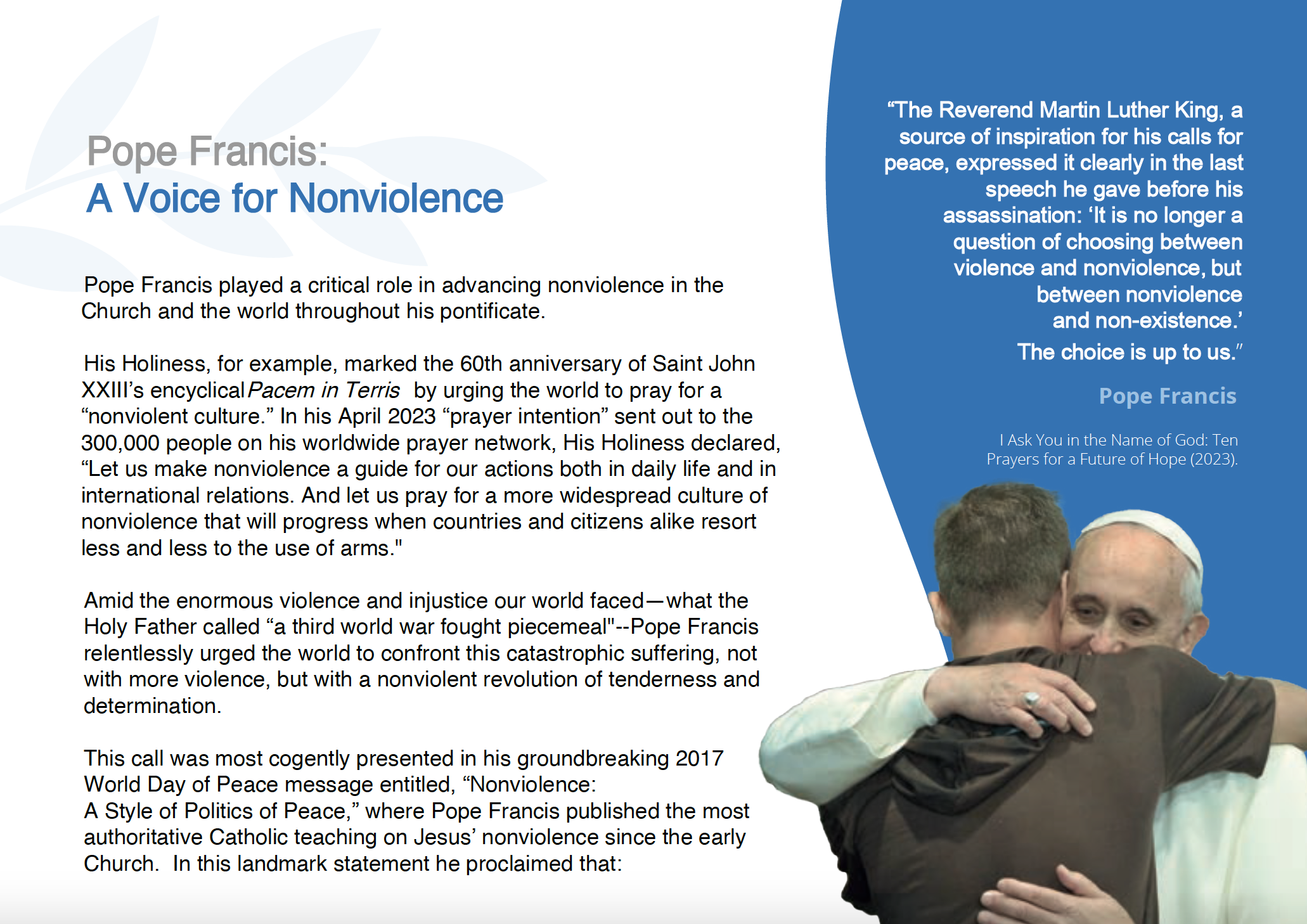
Two years ago Pope Francis marked the 60th anniversary of the promulgation of Saint John XXIII’s encyclical Pacem in Terris[ii] by urging the world to pray for a “nonviolent culture.”[iii] In his April 2023 “prayer intention” sent out to the 300,000 people on his worldwide prayer network, His Holiness declared, “Let us make nonviolence a guide for our actions both in daily life and in international relations. And let us pray for a more widespread culture of nonviolence that will progress when countries and citizens alike resort less and less to the use of arms.”[iv]
Over the course of his papacy Pope Francis played a critical role in advancing nonviolence. His appeal for the world to pray for a nonviolent culture was just one of many calls to the Church and the world to take up the way of active and creative nonviolence in the face of a global culture of violence and injustice. This was a consistent theme of Pope Francis: confronting the reality of violence with active and transformative Gospel nonviolence.
Amid the enormous violence and injustice our world faces—what the Holy Father called “a third world war fought piecemeal,” a global culture of violence including permanent war, growing poverty, threats to civil liberties, ecological devastation, the enduring terror of nuclear weapons, and the scourge of the structural violence of racism, sexism, and economic injustice and other forms of systemic injustice —Pope Francis urged the world to confront this catastrophic suffering, not with more violence, but with a nonviolent revolution.
As His Holiness said to three French activists he met, “Start a revolution, shake things up. The world is deaf; you have to open its ears.”[v] Francis himself was just such a revolutionary. What had been clear from the beginning of his papacy is that what’s needed is a nonviolent revolution, struggling for a world where the well-being of all, especially the most rejected, the most excluded, and the most under attack, is the top priority.
Pope Francis relentlessly taught us that the answer to violence is not more violence. He worked to wean humanity from its tragic belief that violence is the solution. Rather than resolving the great challenges we face, violence often perpetuates and escalates them. His Holiness insisted that there must be another way than violence to resolve conflict, foster justice, heal the earth, safeguard immigrants, and end war.
This “other way” is not avoidance, appeasement, aggression, or attack. It is a dramatically different way of being in the world, of working for peace, of building movements and systems, and of being faithful to the vision of Jesus. In a series of books, presentations, statements, and interviews, he called us to this “other way”: active nonviolence, a core Gospel value that combines the rejection of violence with the power of love and reconciliation in action.

Pope Francis: The Teaching oF Nonviolence
This call was most cogently presented in his groundbreaking 2017 World Day of Peace message entitled, “Nonviolence: A Style of Politics of Peace,” where Pope Francis published the most authoritative Catholic teaching on Jesus’ nonviolence since the early Church. In this landmark statement he proclaimed that:
“To be true followers of Jesus today…includes embracing his teaching about nonviolence”; “In the most local and ordinary situations and in the international order, may nonviolence become the hallmark of our decisions, our relationships and our actions, and indeed of political life in all its forms,” and may we “make active nonviolence our way of life.”[vi]
In this landmark message, His Holiness declared, “I pledge the assistance of the Church in every effort to build peace through active and creative nonviolence.”
But Hs Holiness not only cited the word “nonviolence” with increasing frequency. He has concretely unpacked the distinctive dynamics of nonviolence and how it they are critical to the life of the Church.
This was evident, for example, in a speech he delivered at the Pontifical Theological Faculty of Southern Italy in 2019, where he declared, “…I think of nonviolence as a perspective and way of understanding the world, to which theology must look as one of its constitutive elements.”[vii]
This statement was made in the context of the pope’s vision of theology, which must be conducted “without a spirit of conquest, without a desire to proselytize – which is baneful! – and without an aggressive attempt to disprove the other.”[viii] Theology, instead, must have “[an] approach that enters into dialogue with others ‘from within’, with their cultures, their histories, their different religious traditions; an approach that, in keeping with the Gospel, also includes witnessing to the point of sacrificing one’s own life…”[ix]
Elsewhere in this speech he said: ‘The writings and practices of Martin Luther King and Lanza del Vasto and other peacemakers help us here.”[x]
This was a profound insight. Not only is theology to be a nonviolent enterprise—refraining from “conquest” and “aggression,” and pursued in the spirit of dialogue and encounter—nonviolence and its qualities are “a perspective and way of understanding the world,” not simply a practice or a stance.[xi] This way is illuminated by those who have given their lives to the way of nonviolence, including Dr. King and Del Vasto.
By referencing these nonviolent witnesses virtually in the same breath that he is speaking of the essentials of theology, His Holiness inextricably linked thought and practice, as if to say, “nonviolent action” for which these two figures are remembered is a way of being in the world but also as a way to interpret and live the Christian life.
How did Pope Francis understand this nonviolent lens? For this, we turn to a speech Pope Francis gave when meeting with ambassadors from around the world in December 2016. First, as he says at this venue, nonviolence is a “universal value that finds fulfilment in the Gospel of Christ.”[xii] Second, it is a way of truth that seeks the common good, which calls us to a “nonviolent lifestyle” that is “not the same as weakness or passivity:”[xiii]
“…rather it presupposes firmness, courage, and the ability to face issues and conflicts with intellectual honesty, truly seeking the common good over and above all partisan interest, be it ideological, economic, or political. In the course of the past century, marred by wars and genocides of unheard-of proportions, we have nonetheless seen outstanding examples of how nonviolence, embraced with conviction and practiced consistently, can yield significant results, also on the social and political plane. Some peoples, and indeed entire nations, thanks to the efforts of nonviolent leaders, peacefully achieved the goals of freedom and justice. This is the path to pursue now and in the future. This is the way of peace. Not a peace proclaimed by words but in fact denied by pursuing strategies of domination, backed up by scandalous outlays for arms, while so many people lack the very necessities of life.”[xiv]
Here His Holiness overturned a common stereotype that dismisses nonviolence as weak and passive. Instead, he touted its resolve and courage, but also its search for truth and for the well-being of all. But he also showed why nonviolence is essential to true peace, instead of the “peace” that is often pursued through “strategies of domination” and “scandalous outlays for arms.”
During a 2017 encounter with the Anti-Defamation League, he shared this understanding of nonviolence as a “perspective and way of understanding the world” by proclaiming, “Faced with too much violence spreading throughout the world, we are called to a greater nonviolence, which does not mean passivity, but active promotion of the good.”[xv] For Pope Francis, this “greater nonviolence” was composed of rejecting the temptation of violence, loving our enemies, responding to evil with good (Romans 12:17-21), breaking the spiral of violence, and creating the potential for reconciliation.[xvi]
But accomplishing this requires more than words. Nonviolence is more than a strategy. It is a profound metanoia. Pope Francis shed light on this when he reflected on the war in Ukraine with a delegation of the Ecumenical Patriarchate of Constantinople:
“Before the scandal of war, in the first place, our concern must not be for talking and discussing, but for weeping,for helping othersand for experiencing conversion ourselves. We need to weep for the victims and the overwhelming bloodshed, the deaths of so many innocent people, the trauma inflicted on families, cities, and an entire people. …But we also need to experience conversion, and to recognize that armed conquest, expansionism, and imperialism have nothing to do with the Kingdom that Jesus proclaimed. Nothing to do with the risen Lord, who in Gethsemane told his disciples to reject violence, to put the sword back in its place, since those who live by the sword will die by the sword (Mt 26:52), and who, cutting short every objection, simply said: “Enough!” (cf. Lk 22:51).[xvii]
He then went on to ask, “What kind of world do we want to emerge in the wake of this terrible outbreak of hostilities and conflict? And what contribution are we prepared to make even now towards a more fraternal humanity?” In reflecting on these questions, Pope Francis said:
“As believers we must necessarily find the answers to these questions in the Gospel: in Jesus, who calls us to be merciful and never violent, to be perfect as the Father is perfect, and not be conformed to the world…. Christ is our peace. By his incarnation, death, and resurrection for all, he has torn down the walls of enmity and division between people (cf. Eph 2:14). Let us start anew from him and recognize that it is no longer the time to order our ecclesial agendas in accordance with the world’s standards of power and expediency, but in accordance with the Gospel’s bold prophetic message of peace.”[xviii]
For Pope Francis, “the Gospel’s bold prophetic message of peace” hinges on its most radical and challenging command: to love our enemies, which is underscored in a prayer the pope recited in reflecting on the Ukraine war: “Stop us, Lord, stop us, and when you have stopped the hand of Cain, take care of him also. He is our brother.”[xix]
Pope Francis: Nonviolence in Action
For Pope Francis, nonviolence goes beyond words. Nonviolence required nonviolent action, something he engaged in throughout his papacy, from entering the war zone in the Central African Republic; to making a surprise visit to a refugee camp in Greece, from which he brought three Muslim families to Rome; to making a pilgrimage of repentance seeking reconciliation with the First Nations in Canada who were deeply harmed by boarding schools run by Catholic religious communities; to an unexpected action during a meeting with warring factions in South Sudan:
“In April 2019, Pope Francis hosted a two-day ‘spiritual retreat’ for Salva Kiir Mayardit, the president of South Sudan, and the opposition leaders of that country. The previous Fall, an historic peace agreement had been signed between them, but the parties had been having difficulty implementing it. There was grave danger that this new country would be plunged again into civil war, a conflict that had already cost nearly 400,000 lives. The encounter at the Vatican was an opportunity for dialogue and renewing the task of working for peace for the 13 million people of South Sudan.
At the end of this gathering, Pope Francis pleaded with the leaders to honor the armistice they had signed and to work together as one government. In unscripted remarks, he said, “I beg you as a brother to stay the course of peace. I appeal to you with all my heart: move ahead as one.” Then, unexpectedly, he stooped down and, kneeling on the floor, kissed the feet of President Salva Kiir Mayardit and those of the opposition leaders. He stunned his guests with this altogether surprising gesture.”[xx]
This “nonviolent witness” was a powerful prelude to Pope Francis’ visit to the country in February 2023, which helped, in turn, to inspire a robust commitment by the South Sudanese Council of Churches to nonviolence as a key way forward toward peace in the country.[xxi]
Conclusion
By explicitly using the term “nonviolence” as frequently as he did—and by taking nonviolent action repeatedly—Pope Francis opened the space for theological and pastoral momentum for nonviolence in the Church and the world.
Inspired by Pope Francis, the Catholic Nonviolence Initiative—and Pace e Bene, which has played a key role in this effort since its bneginning—has helped nurture His Holiness’ call to this “revolution of tenderness” in the Church and the world. We are grateful for all he did to spark this emerging resuscitation of Gospel nonviolence. This would not have been possible without Pope Francis, who opened the door more widely to a nonviolent future.
No doubt, Saint Francis of Assisi is joining in with the “jubilation and singing…and the ‘wake of angels.”



ENDNOTES
[i] Adran House, Francis of Assisi: A Revolutionary Life (Hidden Spring/Paulist Press, 2000).
[ii] Pacem In Terris, Encyclical of Pope John XXIII on Establishing Universal Peace in Truth, Justice, Charity, and Liberty, April 11, 1963, https://www.vatican.va/content/john-xxiii/en/encyclicals/documents/hf_j-xxiii_enc_11041963_pacem.html, accessed April 11, 2023
[iii] Vatican News, “Pope’s April prayer intention: ‘For a nonviolent culture,’” March 30, 2023.
https://www.vaticannews.va/en/pope/news/2023-03/pope-francis-april-prayer-intention-nonviolent-culture.html Video: https://www.youtube.com/watch?v=zGmqkZgCcYI
[iv] Ibid.
[v] Loup Besmond de Senneville, “Pope tells young French activists to ‘start a revolution,” La Croix, March 17, 2021.
[vi] Pope Francis, Message, for the Celebration of the Fiftieth World Day of Peace, 1 January 2017, “Nonviolence: A Style of Politics for Peace”
[vii] Speech of the Pope Francis at the meeting on the theme: “Theology of Veritatis Gaudium in the Mediterranean Context”, promenade of the Pontifical Theological Faculty of Southern Italy (Naples, June 20-21, 2019), 06.21.2019 https://press.vatican.va/content/salastampa/it/bollettino/pubblico/2019/06/21/0532/01104.html [B0532]
[viii] Pope Francis, “Theology of Veritatis Gaudium in the Mediterranean Context.”
[ix] Ibid.
[x] Pope Francis, “Theology of Veritatis Gaudium in the Mediterranean Context,”
[xi] Pope Francis’ insight here reminds one of theologian John Dear’s findings: “Nonviolence may be regarded as a hermeneutical lens which brings all the traditional topics of theology, spirituality, and politics into a new focus for our age of global violence. …It is a way of talking about the essential mystery of God as revealed and embodied in Jesus and about God’s active transformation of humanity into God’s nonviolent reign of peace and justice.” Source: John Dear, “Notes for a Theology of Nonviolence,” July 19, 2017, unpublished manuscript.
[xii] “Nonviolence is a typical example of a universal value that finds fulfilment in the Gospel of Christ but is also a part of other noble and ancient spiritual traditions.” ([Pope Francis on Receiving] The Credential Letters of the Ambassadors of Sweden, Fiji, Moldova, Mauritius, Tunisia, and Burundi to the Holy See, 12.15.2016.)
[xiii] Ibid.
[xiv] Ibid.
[xv] Pope Francis, Audience with the Delegation of the “Anti-Defamation League”, 09.02.2017 https://press.vatican.va/content/salastampa/it/bollettino/pubblico/2017/02/09/0087/00213.html. Or this: “Jesus quotes the ancient law: ‘An eye for an eye and a tooth for a tooth’ (Mt 5:38; Ex 21:24). We know what he meant: whoever takes something away from you, you will take away the same thing. It was actually a great progress, because it prevented worse retaliation: if someone hurt you, you will repay him in the same measure, you won’t be able to do him worse. Closing the contests in a draw was a step forward. Yet Jesus goes further, much further: ‘But I tell you, do not oppose the wicked’ (Mt 5:39). But how, Lord? If someone thinks ill of me, if someone hurts me, can’t I repay him with the same coin? ‘No,’ says Jesus: non-violence, no violence.’” Visit of the Holy Father Francis to Bari on the occasion of the meeting of reflection and spirituality “Mediterranean frontier of peace (19-23 February 2020) – Eucharistic celebration and recital of the Angelus, 23.02.2020.
[xvi] Pope Francis, Message, for the Celebration of the Fiftieth World Day of Peace, 1 January 2017, “Nonviolence: A Style of Politics for Peace”
[xvii] “Pope: Christian reconciliation a way toward peace amid ‘senseless’ war,” Vatican News, June 30, 2022:https://www.vaticannews.va/en/pope/news/2022-06/pope-francis-meets-with-ecumenical-patriarchate.html.
[xviii] Ibid.
[xix] Text of prayer for peace in Ukraine recited by pope, Catholic News Service, March 16, 2022: https://catholicnews.com/text-of-prayer-for-peace-in-ukraine-recited-by-pope/.
[xx] Ken Butigan, “A Nonviolent Shift: The Growing Advance of Nonviolence in the Catholic Church and Its Potential Consequences for the Larger World,” a chapter in, “I Have a Dream”: From a Culture of Violence to a Culture of Nonviolence (London Centre for Interdisciplinary Research, 2021), 1.
[xxi] South Sudan Council of Churches (SSCC) Statement on Nonviolence, March 10, 2023. In addition to this powerful statement, we are seeing a growing proliferation of stances on nonviolence by other Church leaders, including Santa Fe, New Mexico Archbishop John C. Wester, who issued a pastoral letter entitled “Living in the Light of Christ’s Peace: A Conversation Toward Nuclear Disarmament” (Archdiocese of Santa Fe, NM, 2022) and Cardinal Robert W. McElroy, who made a major statement on nonviolence at the University of Notre Dame on March 1, 2023 entitled, “Our New Moment: Renewing Catholic Teaching on War and Peace.”
 Seeds Will Grow
Leave a comment