

Cross-posting the following by Mercy Aiken (source).
Things I saw on January 20: A Murder and an Inauguration
Some things I saw today:
A redheaded boy in a red shirt in Gaza. Hours after the ceasefire agreement went into effect, he was making his way back home, through the bombed streets with his donkey, when he was shot by an Israeli sniper. As he lay dying in the dirt, an adult man tried to help him, tried to drag his body to safety, but had to run for his life to escape the same sniper.
The boy had lots of freckles. I know, because I saw a photo of his face after his death, his dark auburn hair in curls around his ears, his eyelashes. He had so many freckles, they covered even his lips. After surviving fifteen months of the heaviest bombardment in modern history he’s dead.
Of course, he’s not the only Gazan, or Palestinian to be murdered since the ceasefire went into effect. But he might be the youngest. I wish I knew his story, how he’d survived fifteen months of war, what his dreams were, who his family is.
Did this egregious violation of the ceasefire make the news at all? Scarcely. Somehow, I suspect that if this child had been Israeli and the sniper Hamas, the outrage over the ceasefire violation would be on everyone’s minds, and Gaza would be pummeled as I write this.
What else did I see?
I saw human bones and skulls, some with bullet holes in them, that have been discovered by people returning to Jabalia. Some of the bones look like they had been gnawed on by dogs.
I saw gray earth, mounds of jagged buildings, and tiny, disoriented human beings wandering through them.
I saw the West Bank:
I saw that the Israeli army sealed all the roads out of Bethlehem and other villages across the West Bank, locking my friends there in mini-open air prisons. I saw traffic backed up for miles, as people could not return home and were locked outside their villages.
I saw a row of sixty-four Palestinian men and boys, the youngest seven years old, forced to lie face down on the dirt before being made to walk in a line with their hands on the shoulders of the person in front of them, looking downward, en route to an Israeli military camp.
I saw Palestinian villages and homes and cars burning, set aflame by violent settlers.
I saw a brand new executive order lifting Biden’s meager sanctions on the most violent settlers on the West Bank.
I saw that I had been foolish to give the one who lifted the sanctions the benefit of the doubt with his “ceasefire deal.” I saw that it was just as I feared, and that his colors were just the same as they’d always been.
I glimpsed a fancy party in Washington DC.
I saw hostage families given seats of honor, just as they were in the previous regime. (I don’t begrudge them that, they’ve suffered so much). But in all the talk of “peace, peace” no one mentioned Palestinian suffering, no one mentioned genocide or what is happening RIGHT NOW. And of course, no Palestinians were given a seat of honor—or a seat anywhere.
Palestinians were, as usual, invisible to the elites. In all this talk about “peace”, the peace for Palestinians is truly and completely irrelevant. Their marginalization is a given. Their suffering taken for granted. It’s permissible. It’s not an issue.
And this is why I am sure they are all the more visible to God.
The fancy party was as elite and garish as the capital in the Hunger Games. It was so shiny that it hurt my eyes to look at it, so loud that it hurt my ears. So, I didn’t look or watch.
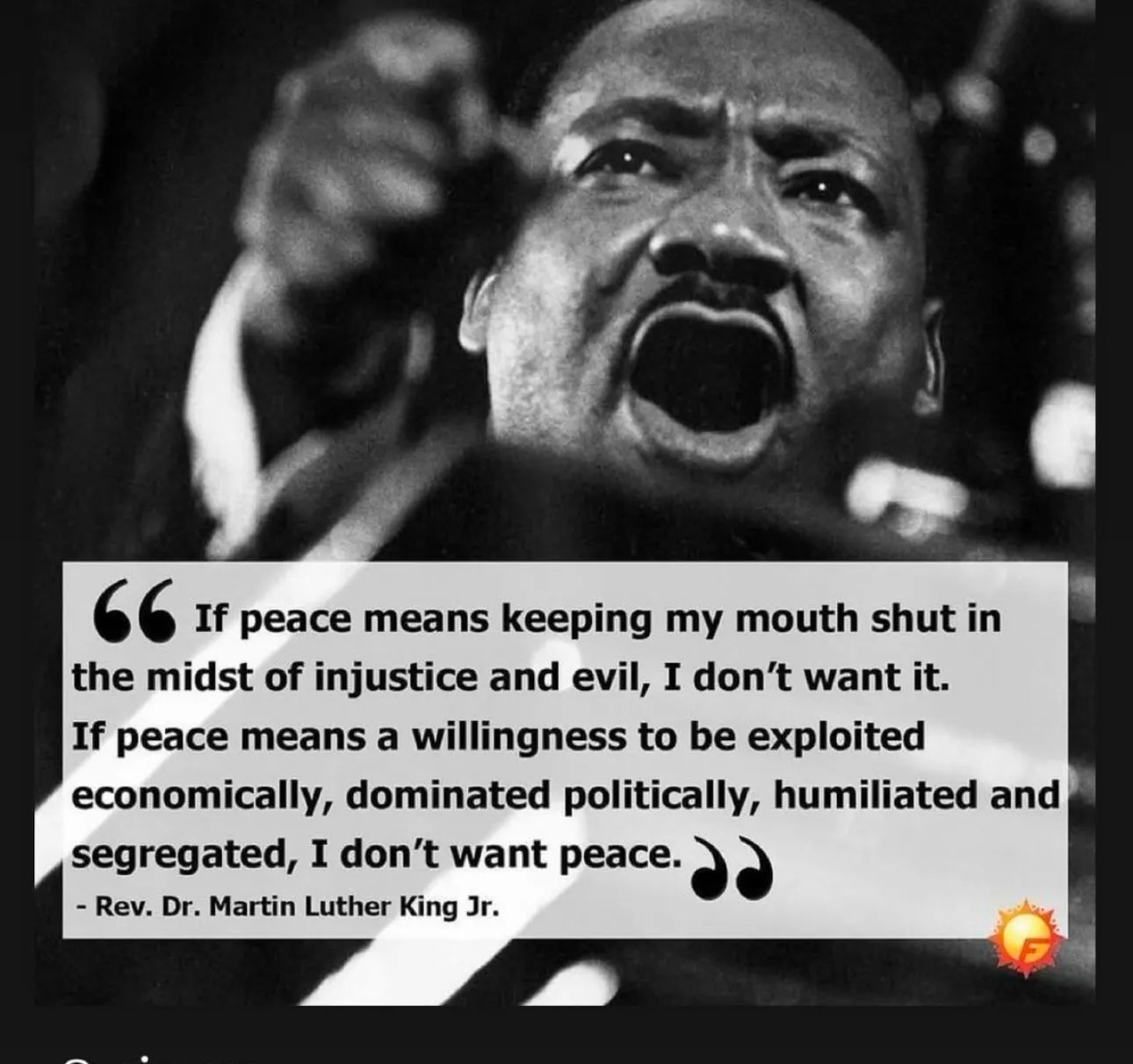
I also saw lots of quotes from MLK today. Here’s a good one. By the grace of God, may we join him in this call and resist every false peace. Let the capital know that we see through them. They are selling tinsel, but we want nothing less than gold refined in the fire.
Mercy Aiken is a peacebuilder with Peace Catalyst International. She will be co-leading a pilgrimage to the Holy Land from June 30-July 11.
The Peacebuilder’s Pilgrimage to the Holy Land is an immersive learning journey through the Occupied Palestinian Territories and Israel, led by experienced peacebuilding practitioners. This unique pilgrimage goes beyond traditional site-seeing to engage deeply with the present-day realities of life under occupation, allowing participants to witness firsthand the efforts for peace and justice in a deeply divided region. Our itinerary includes visits to places such as Bethlehem, Jerusalem, Nazareth, and the Gaza envelope.
While most Christian pilgrimages to the Holy Land focus on ancient sites and “walking where Jesus walked,” few engage with the modern communities on the ground or consider the context of Jesus’s words as one who lived under Roman military occupation. Our pilgrimage not only connects you with the historic Jesus but also with the living Christ, who offers hope to suffering communities today.
Our goal is to help you see a larger and more nuanced story. With the guidance of seasoned leaders who know how to navigate the logistical and bureaucratic roadblocks, you’ll learn about the history and current challenges of Christians, Muslims, and Jews in this land. Together, we’ll explore how faith and ethnicity are being weaponized—and how local peacebuilders are working across deep divisions to create hope amidst one of the longest-running conflicts in modern history.
 Seeds Will Grow
Leave a comment