

Cross-posting a translation of an article posted by Catholic News Here and Now (source)
Hyangkue Lee’s Talk on ‘Peace’
Principal Hyangkue Lee, who runs a Korean school in New Malden, England, participated as a special guest at this year’s Catholic Korea Peace Forum. She shared the understanding of ‘peace’ that she has gained from her experience running a school for children in an neighborhood where South Koreans and North Koreans live together.
Peace is a ‘safe space’ where various parts of life come together
New Malden, located an hour’s train ride southwest of London, is a Koreatown where 20,000 South Koreans and 1,000 North Koreans live together. It is unique in that it is the largest North Korean community outside of Korea and China. Despite being in a third country, South Koreans and North Koreans still have vastly different backgrounds and cultures, and the North Korean community is much more vulnerable economically. The North Koreans who settled in New Malden were those accepted by the UK around the year 2000. This happened as a result of the so-called talmanhan (탈만한, North Korean exodus) phenomenon, where North Korean migrants to South Korea who were unable to settle in South Korea then emigrated to other countries.
Since that time, new residents are mostly descendants of former North Korean resettlers rather than new North Koreans moving in. As a minority population, they do not seem to live openly. This made Lee begin to wonder, “Perhaps North Koreans would also live in this way if ever Korea is unified. So this is why I began observing their lives.”
She explained that although they do not take an open attitude toward the other or actively share their lives, South and North Koreans in New Malden are economically interdependent. “They have relationships as consumers and sellers, employers and employees, and North Koreans are increasingly hiring South Koreans.”
She continued, “The cultural values of North Korea are more recognized and acceptable in the UK than in South Korea. North Koreans are more likely to help each other in concrete ways and value respect for privacy.” Despite that desire for privacy, Lee noted that in New Malden, North Koreans do not hide the fact that they came from the North.
Lee has worked as a volunteer teacher and then principal at a Korean school established by North Koreans, and is now running another Korean language school. The children of North Korean parents and the children of South Korean parents are educated together.
Overcoming different cultures, politics, ideology, and pride
School as a ‘safe space’ where people can live in everyday peace
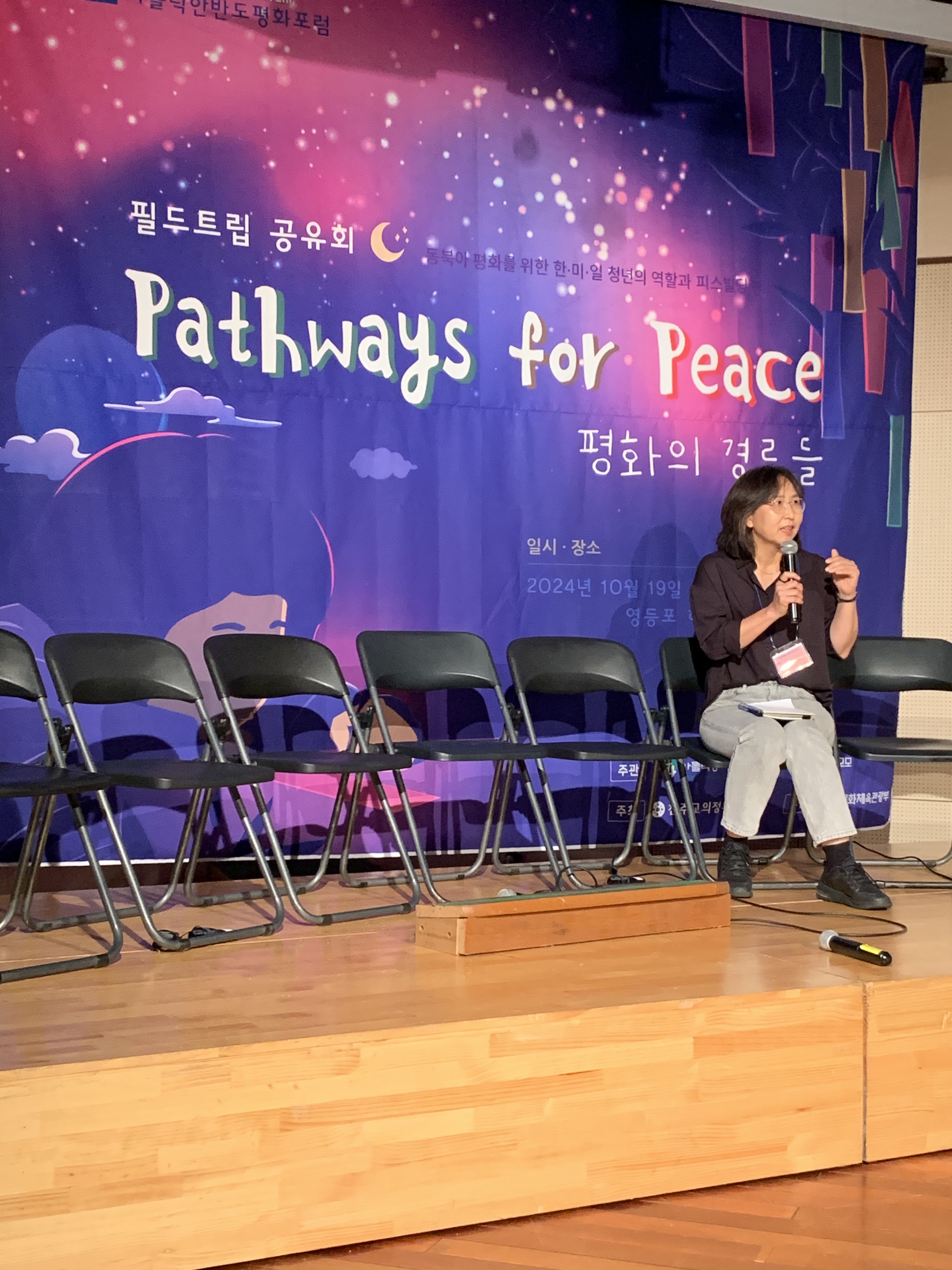
Lee said that in New Malden, the tension and differences between the South and the North still persist. Initially, her biggest concern was talking about a peace upon which Koreans from both countries could agree. She said, “I led a class where the children created a flag for a unified Korea. While drawing a flag with the children, I experienced fear that the anti-communist system was working against me—fear that I could be punished—but the children’s concerns and thoughts about the flag were really great.”
A certain incident led Lee to leave the existing Korean school and create a new school. She said that the question for her while forming the new school was, “What does it mean for South and North Koreans to cooperate with each other?”
Through her past experience, she felt that inter-Korean cooperation was a very serendipitous experiment, through which she was challenged in how to wisely deal with issues of initiative, pride, and gender conflict. She said that in the new school, which is more diverse than the previous school, she feels more empowered and free to think beyond the Korean Peninsula to Asia. “I’m no longer focused on North-South peace issues or reunification, but on what the school should be doing.”
“Teaching Hangeul [Korean literacy] well, letting people experience beauty, giving children with autism and dyslexia what they need, and teaching democracy are the most important things,” Lee said, adding that the value of the school is to create a ‘safe space’ where North and South Koreans can face each other and live together.
“By realizing that it is important to create a peaceful space in everyday life—rather than side experiments or projects—we were able to free ourselves from the burden of mechanically considering North and South Korean factors,” Lee said, adding, “Making the decision together that a South Korean will be the principal and a North Korean will be the parent chairperson—creating a quality space where North and South can come together is what it means to be a ‘school.’”
 Seeds Will Grow
Leave a comment