Young adults from South Korea, the U.S., and Japan gather, seeking “Paths to Peace.”
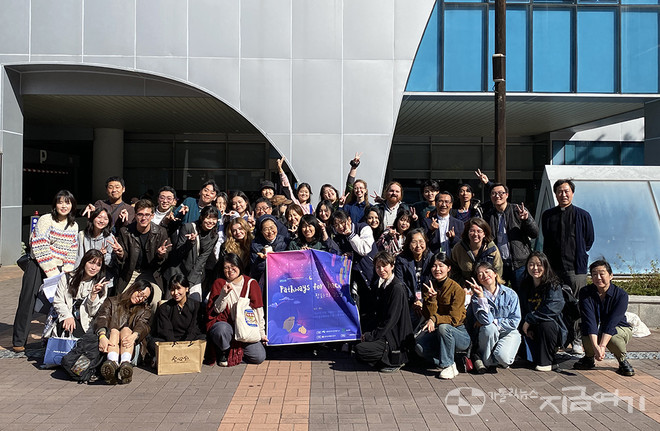
This year’s Catholic Korea Peace Forum was held from October 16-20th with participation of young people from South Korea, the United States, and Japan.
The forum has been held annually since 2017 and in collaboration with the churches of South Korea, the United States, and Japan since 2022. This year’s forum was organized by Peacemomo, the Catholic Institute for Northeast Asia Peace, and the Diocese of Uijeongbu.
While the forum has always included youth participation and programming, this year’s event was the first dedicated entirely to programming, activities, and dialogue with young adults. More than 40 people took part in the forum, including young people, priests and religious participants from the United States, the United Kingdom, Japan, and South Korea.
The forum began with a welcome address and peace games held at the Uijeongbu Diocese’s Church of Repentance and Atonement on September 17th. On the 18th, participants made field trips to Gunsan, Gyodong-do, Soseong-ri, Daejeon, Samcheok, and Cheorwon, and on the 19th, they shared their field experiences at an event featuring musical performances and a documentary screening. The last day ended with a program summary and sharing, followed by mass at the Joint Security Area (JSA) Cathedral in the DMZ.
Photo 1: Mass at JSA Cathedral (Photo courtesy of the Catholic Institute for Northeast Asia Peace)
The Peace Games program was a simulation of negotiations and agreements for the Northeast Asia Peace Process, based on United Nations Security Council Resolution (UNSCR) 1325, adopted by the UN Security Council on October 31, 2000, and the 2020 Report on Women, Peace and Security.
UNSCR 1325 emphasizes the importance of women’s participation in conflict prevention and resolution, peace negotiations, durable peacebuilding, and provision of humanitarian response. It calls on Security Council member states to increase women’s participation and to include a gender-sensitive perspective in all UN peace and security efforts.
The scenario for negotiation and consensus-building presented to the young adult participants from South Korea, the United States, and Japan was creating an action plan for implementing the four pillars of UNSCR 1325 (women’s participation, protection of women in wartime and refugee situations, prevention of violence against women, and relief and recovery to address international crises from a gendered perspective) in Northeast Asia, including for China and North Korea.
Participants role-played delegates from South Korea, North Korea, the United States, China, and Japan and engaged in negotiations about how to prevent and respond to war crimes and violence against women in Northeast Asia.
When it was all said and done, one participant reported, “It was difficult to competently express a position and attitude in an environment with diverse national representation. It was also challenging to represent another country’s position when one’s own nation’s interests and personal beliefs are different.”
Through the negotiation simulation, one participant realized “how difficult it is to communicate with an open mind while holding a fixed position that you must represent. Each country is sensitive to public opinion, so building popular consensus for peace is important. We realized how productive it is to get out of your own head and talk face-to-face.”
“I don’t want peace to be achieved through force, but as I immersed myself in the role of a negotiator, I realized how great the influence of force can be, which made me think a lot,” a participant reflected.
Photo 2: At the Gunsan Peace Museum. (Photo courtesy of the Catholic Institute for Northeast Asia Peace)
Pathways to Peace, Learning from History Cultivating Peace at the Site of Violence
On the third day, the youth were divided into six groups and visited Gunsan, Saemangeum and Haje village; Gyodong-do, an island inhabited by people displaced during the Korean War; Soseong-ri; Daejeon, the site of Golryeonggol and Daejeon Prison; Samcheok; and Cheorwon. These are sites of violence from the Japanese colonial period and massacres in the Korean War, an area suffering from the installation of the THAAD missile system, frontlines of struggle in the anti-nuclear and anti-coal movements, places where many people were displaced for the construction of a military airfield, and the location of the division of the Korean Peninsula.
“The hidden massacre sites were shocking. I didn’t know this history of South Korea, and it was heartbreaking to learn that North Korea also suffered from civilian massacres… I hope that a park is built to remember the victims, where their living descendants can go to pray.” (Christina, USA, in Golryeonggol, Daejeon)
“Before I participated in this program, Samcheok’s Maengbang Beach, which I had seen in pictures, was already gone. All due to the extensive destruction caused by the construction of a power plant. As Pope Francis has said, our task today is reviving the ruined land. We must continue to live while opening up a creative future.” (Fr. Joseph, Japan, in Samcheok)
“I chose to visit Gyodong Island, because it was the closest destination. Despite being called the ‘Island of Peace’ in the neutral waters of the Han River estuary, there was still a lot of unrest and scars from the war and the current inter-Korean situation. The only place where the scars were not visible was at the market, and I think it was because there are people there—not violence and ideology. Even if we can’t eliminate violence from the face of the earth, I think we must remember the horrors of war.” (Byungju Park, South Korea, on Gyodong Island)
Photo 3: Participants standing in solidarity in Samcheok. (Photo courtesy of the Catholic Institute for Northeast Asia Peace)
“We were told that the spirit of peace has a positive and proactive nature, that peace activists are doing what they feel responsible to their community to do, and that we all have responsibility for the peace movement. The spirit of peace resembles how practitioners of various spiritual traditions approach prayer. I think that religious beliefs can offer conviction for peace. It gave me courage that I can play a role for peace, even though I am used to peace through strength.” (Jongseok Jung, South Korea, at the Cheorwon Demilitarized Zone)
“Soseong-ri has been a site of struggle where the logic and belief in peace have been normalized. The installation of the THAAD missile system was illegal, unequal, and illogical. Japan also has THAAD, and it is a global issue. I was deeply moved by the residents who sacrifice their lives for peace.” (Participants in Soseong-ri)
“Nature will survive longer than humans, and we need to protect it in the face of militarization. This land, this planet, does not belong to Korea; it does not belong to the United States; it does not belong to humans alone. Nevertheless, we draw lines and destroy nature with consideration only for human needs. Just as the birds of Saemangeum fly without boundaries, I hope we humans can interact freely without drawing lines.” (Tomoki, Japan, in Gunsan)
Regardless of their diverse nationalities and professional roles in Korea, the United States, and Japan, participants who visited these different sites pointed out each location’s historical significance and shared their reflections on finding a path to peace through the witness of the land and the people who are still suffering.
Photo 4: Bishop Peter Lee Ki-heon with the youth. Photo courtesy of Reporter Jung Hyun-jin
Bishop Peter Lee Ki-heon, former bishop of the Uijeongbu Diocese, was present throughout the event and said, “Today was the most joyful and happy day I have ever had.”
Bishop Lee said, “We are living in a very heavy, dark, and painful time, but the power to be together like this is solidarity. I think solidarity is also the greatest condition for peace.” He added, “My heart has been sick and heavy watching recent developments in our world. Seeing you young people—who are diligent professionals in your own fields—come together to stand in solidarity for peace and for many lives has renewed my hope. I rejoiced with happiness to feel the power of your solidarity.”
The program contained presentations by the young adults, musical performances by the Kamkam Band and Morae do Toyoil (모레도토요일), and a screening of the documentary ‘Can I Now Ask you to Pray (CINAP),’ directed by Hanna Suh (Shalom Society, 샬롬회).
Photo 5: On the third day of the forum, after visiting different field sites, participants share their experiences and thoughts about the path to peace. ⓒHyunjin Jeong
On the final day, after finishing the program, Hannah Lee, a student at the University of Pennsylvania in the United States, told Catholic News Here and Now, “It was really great to be able to share with people from diverse cultures and backgrounds. We came from various locations, professions, and nationalities—from students to office workers.” She added, “I have been feeling some religious doubts lately, but during this time, I was able to think deeply about peace from a religious perspective. It was a time of personal healing. It was a truly valuable experience to see, talk about, and learn more about peace on the Korean Peninsula.”
Jeong-Shim Lee (Munsan Church, Uijeongbu Diocese) from South Korea said that although the program was intense and could have been tiring and exhausting, participants were able to unite with each other to have a great experience and make really good memories. “I have only recently become interested in and begun studying peace, so I was curious about other people’s thoughts. I learned that peace is less a matter of a strict definition and more a way of life,” she said.
“The participants from South Korea, the U.S., and Japan tried to communicate with each other despite the language barrier. They tried to understand each other using various methods and listened with their whole hearts. I thought that in itself was the beginning of peace,” she added.
Masaoka Yoshiki, who works as a hospice nurse in Japan, said he became involved because he wondered how to live in peace with his patients. His Korean mother and Japanese father gave him the Korean name ‘Kim Seo-ro,’ meaning ‘loved by both countries.’ Reflecting about the forum, he said, “Verbal communication was difficult. Although it was difficult to fully understand what was being said, I could see sadness in the eyes of the people I was with, and I could also read the anger and regret in their eyes. I was very proud to be able to participate in the program, while sharing those feelings.”
He went on to express, “Until now, I thought that apologies and repentance were expressed only in words, but through this experience, I realized that being able to comfortably stay in the same space with people so different from oneself can also become an apology and reconciliation.”
Photo 6: At the end of the day. ⓒ Reporter Hyunjin Jung



 Seeds Will Grow
Leave a comment