

In 2019, 17% of US manufacturing was military. That’s huge.
(I don’t know the 2024 percentage, although the Pentagon’s budget has risen in the last 5 years – outpacing inflation.)
Imagine that your local supermarket were a reflection of USA manufacturing. You would walk in those automatic doors, feel the cool air-conditioning sweep over your skin, and as your eyes scanned the aisles before you, you would see 17% of the shelves stocked with made-in-the-USA, military grade equipment… nearly 1/5th of the shelves would be full of death machines.
These weapons are what our nation manufactures, what we export to our 900 US military bases overseas, and what our government officials market and sell to foreign parties all around the globe (we have 41% market share in global military sales – the largest weapon dealers by far).
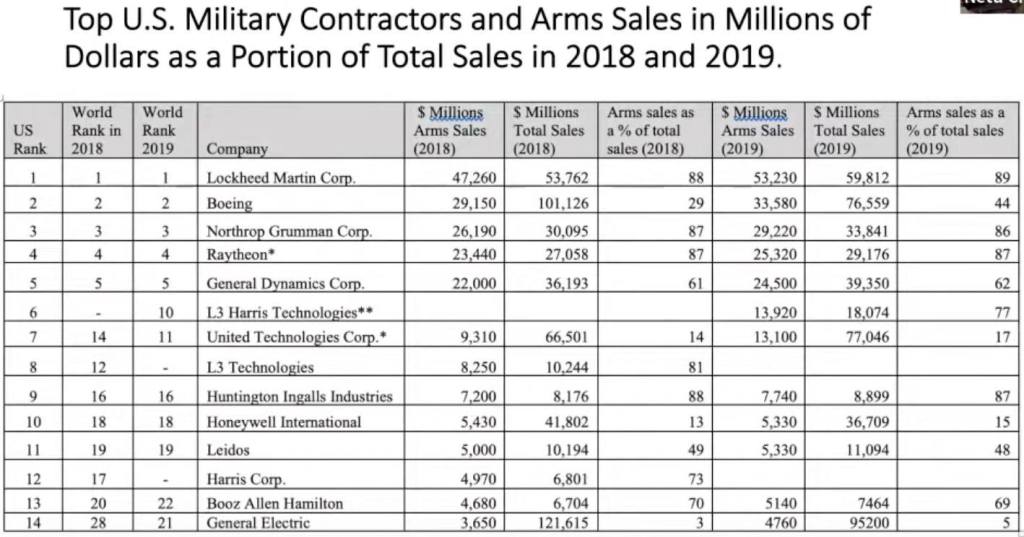
Check the screenshot below from Neta Crawford’s presentation to see the top US military industrial players and their arms sales as a total percentage of company sales.
Imagine an America where these companies converted their arms manufacturing into products that promote and enhance life, rather than tools of destruction and weapons of death. What if we manufactured products that would lead to a healthier world? Invested more in human security and human development? What could we change to create a more just economy? A more dignified world?
Footnotes
- The numbers and screenshot in this post come from researcher Neta Crawford, from the Costs of War Project at Brown University.
- If you did not know that US diplomats make weapons deals, this podcast breaks it down.
- If you’re shocked to hear that the US has so many military bases beyond our borders… here’s an article about it, and a visual database of the empire.
- Three ideas for transforming the military industry:
- Conversion. From Huntsville, Alabama – engineers leaving the war economy to innovate renewables and green energy: “I don’t think this is the future, and I don’t feel this is a story that I want to be part of and then tell my kids: Hey, this is what I did. Like, I was helping to destroy the world.” “It’s not about getting rid of jobs. It’s about transforming the workforce.” (read more)
- Nationalization. Some economists believe taking profit out of war would solve a lot of the problems the private military corporations have created. (read more)
- Reduction. In 1961, President Eisenhower warned of the problems to come from the growing military industry. The U.S. is “the top militaristic contributor in the world” – a tragic waste of resources toward destruction when there’s so much life to cultivate, human capital to develop through education, and innovation potential. At least we could reallocate a percentage of the war budget toward a peace economy. (read more)
- More on creating a just economy:
- For those of you who want to pressure the war profiteers to change, check out Warheads to Windmills.
 Seeds Will Grow
Leave a comment